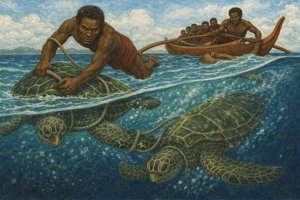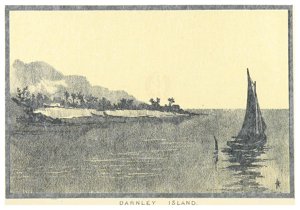


On the southern side of Badu there are two islands, Zurat and Kwoberkelbai, much resorted to by turtle, great numbers of which were caught by the inhabitants.
On Kwoberkelbai lived a man named Gabakwoikai, and one morning the men at the village told him they had seen turtle-tracks on the beach at Zurat. "All right," he replied, "I will go." So he started off, but, instead of taking a canoe, he simply sat on the steering-board (walunga) of a canoe and paddled himself across to Zurat. He soon found the eggs, dug them up, and rolled them in a bundle of grass, leaving them on the shore while he went to look for some fruit.
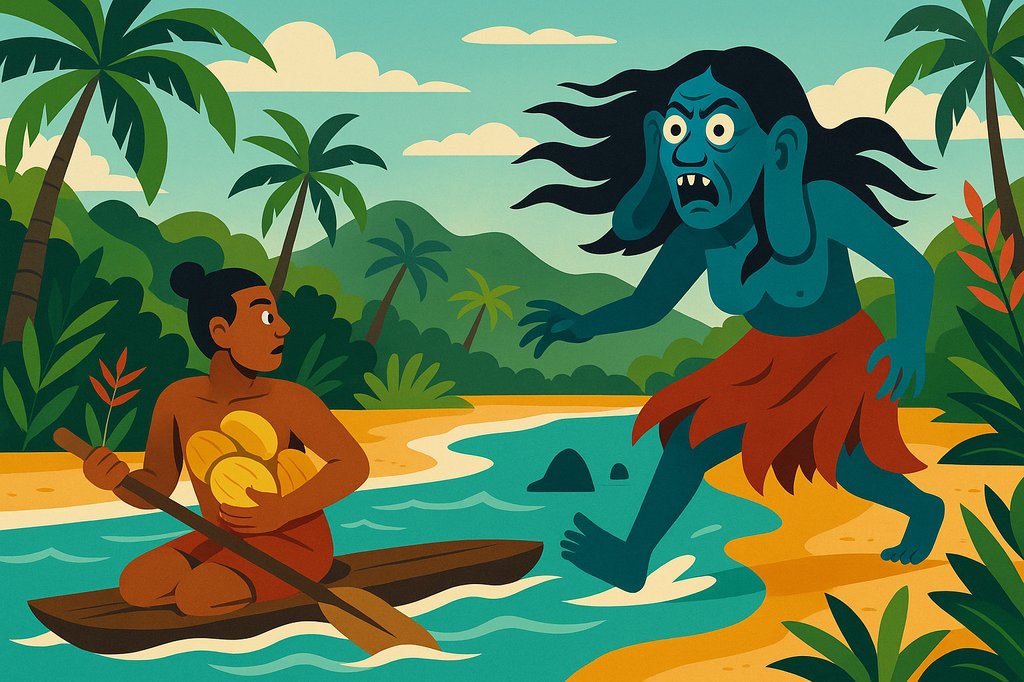
The Dorgai who lived on the other side of the island had made a basket ready, and then had gone to sleep for a week, so that plenty of fruit might ripen and fall ready for her, and it chanced that she woke the same day and went to gather her harvest. Gabakwoikai, having picked up all the fallen fruit, climbed up into the tree to gather more, and did not see the Dorgai's approach. The latter, not finding fruit lying on the ground as she expected, exclaimed, "Ulloa! where all fruit go to?" Gabakwoikai, hearing the Dorgai's voice, looked and saw the dreadful apparition of a hideous, big-bodied woman with long legs but small feet, and ears so enormous that she could sleep on the one whilst the other covered her like a mat. The Dorgai, hearing him say in great fear, "What I do now?" looked up and saw him in the tree. "Who tell you come here? place no belong to you—fruit belong to me—you steal—bring down all the fruit." Gabakwoikai said, "You think I bloody fool take fruit for you. I can't, my belly no got kaikai (food)." "Give me the unripe ones, so I fill my basket," replied the Dorgai; so the man dropped one, and it fell close to her; she stretched out her hand for it. Gabakwoikai threw another, and the Dorgai took two steps to get it; a third was thrown still further, so that the Dorgai had to take four steps; having picked it up she returned to the tree. Gabakwoikai then heaved one on to the top of a tree near the Dorgai's house, and whilst she went for it he clambered down the tree and ran to the shore, carrying the fruit. On arriving at the beach he picked up the eggs and embarked on his board.
The Dorgai, returning to the tree, found that Gabakwoikai had decamped, and followed his footprints; the latter, seeing he was pursued, said, "He (=she) come now." The Dorgai, arriving on the beach, called after him, "You come, come now"; to which he replied, "Think I bloody fool go along you—I go back." The men at Kwoberkelbai, looking across the strait, exclaimed, "Ulloa! Gabakwoikai run; Dorgai frighten him." Gabakwoikai returned home, gave the eggs to the old men, then put some red paint in the kwod (men's or bachelors' quarters); a brother-in-law took some, saying, "All right, we go and kill Dorgai." All equipped themselves with their dugong and fish-spears, leaving their bows and arrows behind.
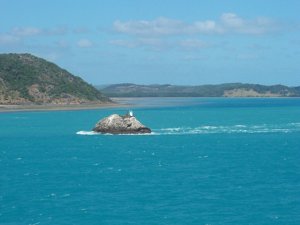
The Dorgai was in her house asleep when the men arrived. Gabakwoikai said, "Dorgai wants to sleep"; he then took a dugong harpoon, whilst all the rest sat on her house, aimed it at her, but managed only to transfix her arm with the dart to which the rope was attached. The Dorgai jumped up and ran away to windward, the men holding by the rope just as if she were a dugong. The Dorgai sank into the ground and made water—the spot is to this day a water-hole or well—but soon emerged and ran away again. The Dorgai sank a second time, more deeply, in soft ground. "What we do now?" said the puzzled men; "Dorgai go a long way." They took a turn of the rope round a tree and pulled; they tugged so vigorously, in fact, that the arm of the Dorgai was wrenched off. Shouting in triumph, the men returned to the beach, flung the arm into the sea, and the tide being low, it projected above the level of the water, and is still to be seen as a rock on the reef named Dorgai Zug. The men then returned home, but the Dorgai died in the ground.