


Eden Hall, the seat of the chief of the famous border clan of the Musgraves, is a large and handsome edifice on the western bank of the River Eden.
It was built in the style which prevailed about the time of the two King Charleses.
Bordered by trees, it forms an elegant feature in the pleasure grounds.
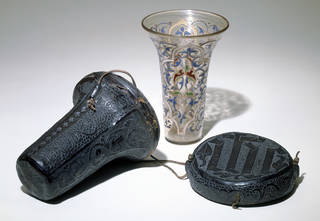
There is preserved within it, with scrupulous care, an old painted glass goblet called the “Luck of Eden Hall”.
According to the following traditional legend, the vessel appears to be inseparably bound to the fortunes of its possessors.
The butler, while going to fetch water from St Cuthbert’s Well in the neighbourhood — a rather unusual occupation for a butler — suddenly came upon a company of fairies feasting and making merry upon the green sward.
When they fled, they left the glass behind them.
One of the fairies returned to recover it, but found it already in the butler’s hands.
Seeing that all hope of recovering it was lost, she flew away, singing aloud:
If that glass should break or fall,
Farewell the Luck of Eden Hall.
The association of a family’s prosperity with the preservation of an inanimate object has frequently been one of the playthings of tradition, and traces of such superstition may be found in ancient fables.
A legend of this kind is attached to a pear preserved in a silver box at Coalstoun, the seat of the Earl of Dalhousie, near Haddington.
There is, or formerly was, a glass cup at Muncaster Castle, given by Henry VI to Sir John Pennington.
Because of the general belief in the king’s sanctity, and because he was said to have bestowed a blessing upon the family together with the gift, the vessel became known as the “Luck of Muncaster”.
The initials I. H. S. are marked upon the case containing the goblet at Eden Hall, sufficiently indicating the sacred purpose for which it was originally intended.
Philip, Duke of Wharton, alludes to it in his ballad known as The Drinking Match of Eden Hall:
God prosper long, from being broke,
The Luck of Eden Hall!
A doleful drinking bout I sing,
There lately did befall.
To chase the spleen with cup and can,
Duke Philip took his way;
Babes yet unborn shall never see
The like of such a day.
The stout and ever-thirsty Duke
A vow to God did make;
His pleasure within Cumberland
Three live-long nights to take.
Sir Musgrave, too, of Martindale,
A true and worthy knight,
Eftsoon with him a bargain made,
In drinking to delight.
The bumpers swiftly passed about,
Six in a hand went round;
And, with their calling for more wine,
They made the hall resound.
Now, when these merry tidings reached
The Earl of Harold’s ears,
“And am I,” quoth he, with an oath,
“Thus slighted by my peers?
“Saddle my steed, bring forth my boots,
I’ll be with them right quick;
And, master sheriff, come you too,
We’ll know this scurvy trick.”
“Lo, yonder doth Earl Harold come!”
Did one at table say.
“’Tis well,” replied the mettled Duke;
“How will he get away?”
When thus the Earl began: “Great Duke,
I’ll know how this did chance,
Without inviting me; sure this
You did not learn in France.
“One of us two, for this offence,
Under the board shall lie;
I know thee well; a Duke thou art,
So some years hence shall I.
“But trust me, Wharton, pity ’twere
So much good wine to spill,
As these companions here may drink,
Ere they have had their fill.
“Let thou and I, in bumpers full,
This grand affair decide.”
“Accursed be he,” Duke Wharton said,
“By whom it is denied.”
To Andrews and to Hotham fair
Then many a pint went round;
And many a gallant gentleman
Lay sick upon the ground.
When, at the last, the Duke perceived
He had the Earl secure,
He plied him with a full pint glass,
Which laid him on the floor.
Who never spoke more words than these,
After he downward sunk:
“My worthy friends, revenge my fall;
Duke Wharton sees me drunk.”
Then, with a groan, Duke Philip held
The sick man by the arm,
And said: “Earl Harold, ’stead of thee,
Would I had drunk this pint.
“Alack! My very heart doth bleed,
And doth within me sink;
For surely a more sober Earl
Did never swallow drink.”
With that the sheriff, in a rage,
To see the Earl so smit,
Vowed to revenge the dead-drunk peer
Upon renowned Sir Kit.
Then stepped a gallant squire forth,
Of visage thin and pale;
Lloyd was his name, and of Gang Hall,
Fast by the River Swale.
Who said he would not have it told,
Where Eden River ran,
That unconcerned he should sit by:
“So, sheriff, I’m your man.”
Now, when these tidings reached the room
Where the Duke lay in bed,
How that the squire so suddenly
Upon the floor was laid:
“O heavy tidings!” quoth the Duke.
“Cumberland, thou witness be,
I have not any toper more
Of such account as he.”
Like tidings to Earl Thanet came,
Within as short a space,
How that the under-sheriff, too,
Was fallen from his place.
“Now God be with him,” said the Earl,
“Since ’twill no better be;
I trust I have within my town
As drunken knights as he.”
Of all the number that was there,
Sir Bains he scorned to yield;
But, with a bumper in his hand,
He staggered o’er the field.
Thus did this dire contention end,
And each man of the slain
Was quickly carried off to sleep,
His senses to regain.
God bless the King, the Duchess fat,
And keep the land in peace;
And grant that drunkenness henceforth
’Mong noblemen may cease!
J. H. Wiffen wrote a short poem upon the Luck of Eden Hall, and the German poet Ludwig Uhland composed a ballad upon the same subject.
The Musgraves are a family of great antiquity and reputation.
They came to England with the Conqueror and first settled at Musgrave in Westmorland, then at Hartley Castle in the same county, and finally at Eden Hall.
Sir Philip Musgrave, who commanded the king’s troops in Cumberland and Westmorland during the Parliamentary War, makes a brief appearance in Scott’s Legend of Montrose.
The novelist, however, mistakenly calls him Sir Miles.