
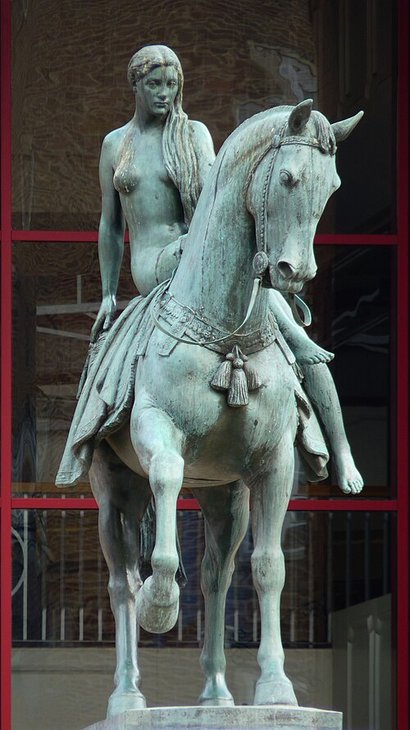


The story of Lady Godiva is, perhaps, the best and most widely known of all the legends of Warwickshire.
Hundreds of thousands have at different times “waited for the train at Coventry,” and, as they watched “the three tall spires,” have thought of the fair and beautiful wife of the stern Earl who overtaxed the people.
They have pictured to themselves the women coming to the lady with their children, clamouring:
“If we pay this tax, we starve,”
and how she went to the Earl and besought him to relieve them of the tax.
How he told her:
“You would not let your finger ache
For such as these?” “But I would die,” said she.
He laughed, and swore by Peter and by Paul;
He filliped at the diamond in her ear;
“O! ay, ay, ay, you talk.” “Alas,” she said,
“But prove me what it is I would not do.”
And from a heart as rough as Esau’s hand
He answered, “Ride you naked thro’ the town,
And I’ll repeal it.”
The heralds went forth and, in the hot breath of noon, with her rippled ringlets flowing, they knew how the fair Godiva flitted from pillar to pillar “like a sunbeam,” and then rode through the silent streets “clothed on with chastity,” and thus:
“Took the tax away,
And gave herself an everlasting name.”
It is a beautiful legend, beautifully told by the Poet Laureate, but, unfortunately, it is not true.
But, unlike the story of Guy, there was a Lady Godiva—a lady historically renowned for her piety, her beauty and her charity.
She was the daughter of Thorold, Sheriff of Lincolnshire, the founder of Spalding Abbey.
Her husband, Leofric, Earl of Mercia, had a residence at Coventry, probably at Cheylesmore, since that manor was afterwards claimed by his descendants.
He and his wife were liberal benefactors to the ecclesiastical foundations of Worcester, Coventry, Evesham, Chester, Leominster, Wenlock and Stow-in-Lindsey.
Coventry was the most magnificently endowed and was wealthier than all the others.