


In the lap of the eternal sun reposed the Massatonguas. Purgation from every sin against the Great White Spirit gave them a land in which perfection was seen in every contour of nature, and happiness was as illimitable as the spiced breezes these favored children breathed.
Birds of exquisite plumage filled the branches of the trees and carolled their music, like sweetest symphonies, unceasingly. It was in a charming plain the Massatonguas lived, through which flowed a pearly river whose bosom was as graceful as the swell of a maiden’s, and whose banks were hidden by a profusion of flowers, the exhalations from which were as incense to the air. The arch of heaven bordered the confines of this beautiful land, and the happy Massatonguas were ruled by the White Spirit who, during every hour, gave them new blessings and evidences of her love.
Thus lived in undisturbed peace and happiness the Massatonguas through the long years, like a song the melody from which grows sweeter to the close, and with faint and dying echo leaves its beauty in our memory.
The river which bathed this lovely plain had its source hidden in the edge of the ethereal paradise, but its outlet was a cave the mysteries of which none were allowed to explore. This was the only condition imposed by the ruling White Spirit, an observance of which was the guarantee of perpetual happiness to the Massatonguas.
But ages of pleasure, with ignorance of pain, at length created discord and restlessness among the tribe. Curiosity excited a desire to explore the mysterious cave, in the recesses of which it was fabled there were beauties greater than the eye of mortal had ever seen; that it was the portal of a new world peopled by elves of surpassing loveliness, whose wigwams were of precious stones and the rivers of molten gold.
The White Spirit besought them to abide their already happy condition and avoid the penalty which disobedience would entail. Her words were like drops of crystal on the rocks: they gave back a sound but made little impress upon the adventurers’ purposes.
A council was called which all the tribe attended. The wise men, whose conceit had impaired their wisdom, addressed the assembled multitude and repeated the stories of the mysterious cave, the portal of a new world. The witchery of these myths created an ambition in the tribe never felt before; there succeeded to a contented disposition a consuming desire for a new condition. The harmony of the birds, the incense-laden air, the beauty of the landscape with its graceful undulations garlanded with rare exotics, lost all their charms in the wild infatuation for the exploration of the forbidden cave, and soon the sound of the sharp stone axes was heard like a tone of bewailing and ominous destiny, mingling with the music of the plumed foresters.
The boats were built and, when launched, floated so majestically upon the pearly river that a shout of joy went up to the very heavens from the Massatonguas— which caused the White Spirit to weep in copious rain and show her anger in the loud peals of thunder and flashes of fire which dashed across the now black and portentious sky. Many of the tribe were stricken with terror, but when the sun again shone through the riven clouds and a calm hung over their beautiful land, fear was dispelled and their determination renewed.
The tribe again assembled on the margin of the river and, amid huzzahs of delighted anticipation, the embarkation commenced. More than a hundred canoes, freighted with a score of Massatonguas each, glided gracefully out upon the beautiful water and were borne swiftly towards the black portal. The camp fires died out, and hushed was the music of the birds. A strange rushing of the winds was heard overhead and the river rolled uneasily, torturing its course like a wounded serpent. The sun was again veiled by inky clouds, and from out the boiling elements came the voice of the White Spirit:
“Thou shalt see a new world indeed, but the penalty will be eternal sorrow.”
But onward sped the boats, and with minds drunk with fancy the Massatonguas’ hearts were light, and merrily they drifted.
Two days did the journey thus continue, but at eventide the boats approached the yawning and mysterious cave out of which poured startled birds of filthy wings terminating with bony claws, and teeth like serpents’ fangs. The last boat having floated within the entrance of this dark cavern, suddenly a peal of thunder sounded which shook the arch of this now sepulchre and made the water boil, while a stifling odor arose and volumes of steam filled the space almost to suffocation.
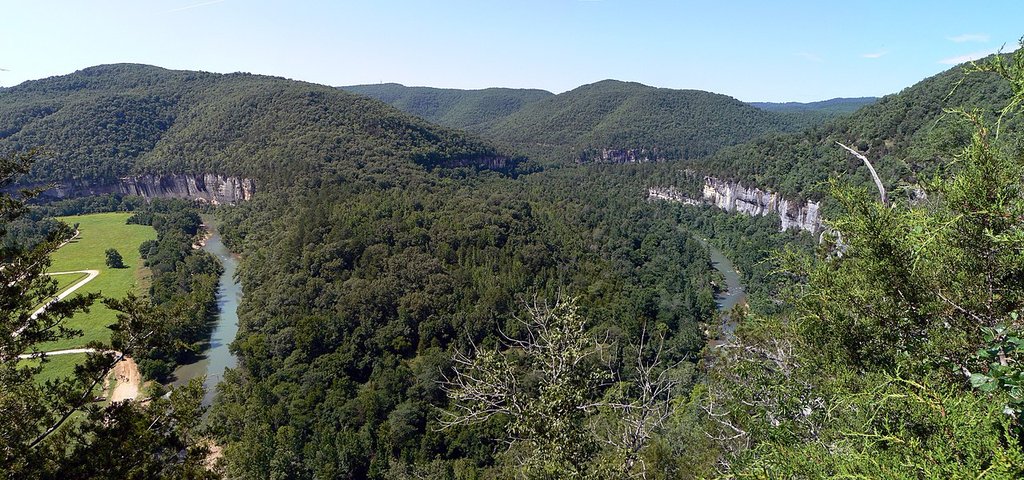
Looking backwards the Massatonguas saw the portal close and shut out the light of day from them forever. The river sank in its bed and from the depths of that beautiful stream the White Spirit upheaved the earth and left a range of mountains now called the Ozarks.
Still live the Massatonguas in eternal sorrow. Under the mountains, in the pall of perpetual darkness, they weep and toss their pain-laden bodies in despair. Their tears have worn crevices in the rocks through which they trickle unceasingly. In the quiet of the night at the base of Crystal Mountain the moans of the imprisoned Massatonguas may often be heard, and the rush of strange wings sweeps over the Ozark range once every year; but never the voice of the Great White Spirit is heard again.