
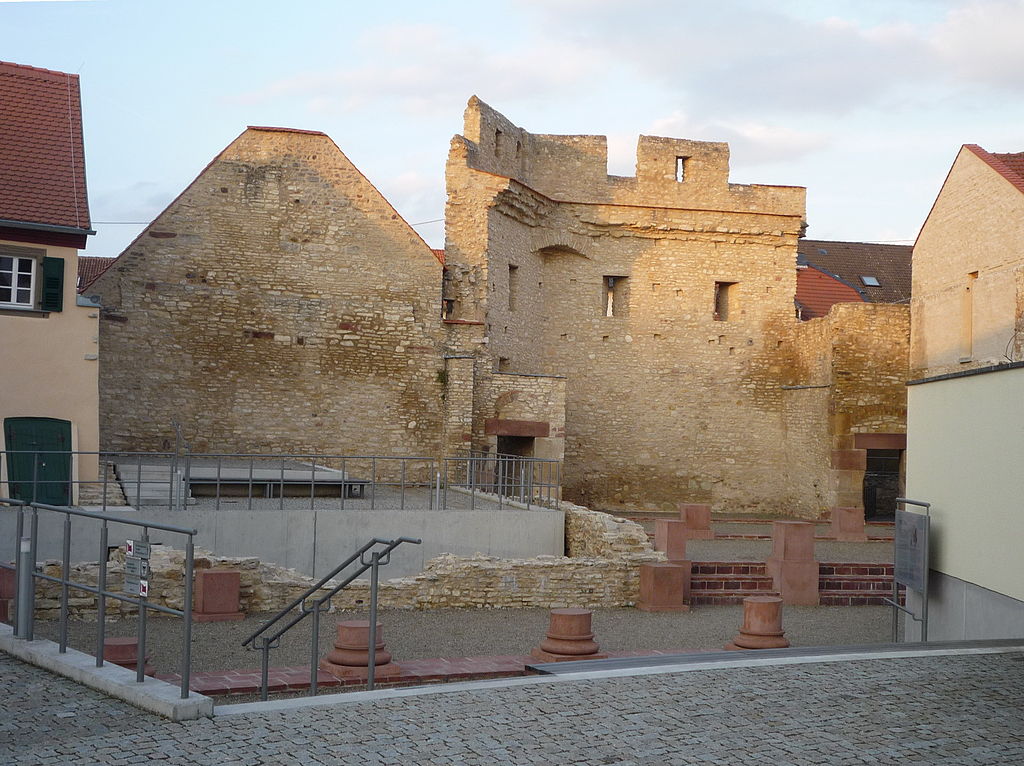


Charlemagne had had a new palace built for him in a beautiful spot near the Rhine. When it was completed, he went to visit it. On the first night that he slept in the palace, a very strange incident occurred. An angel came and stood beside his bed.
“Arise,” it seemed to say to him. “Arise, go forth, and enter secretly into the house of Arnot.”
The Emperor was so astonished by this command that he did not know what to do. He could scarcely believe that such an order could come from an angel, so he did not move. But the command was repeated, and then repeated once again.
When the angel commanded him for the third time to go and enter secretly into the house of Arnot, he arose, went quietly to his stable, saddled his horse himself, and rode silently out into the darkness in the direction of the home of Arnot, one of his most trusted ministers.
As he rode thoughtfully along the dark road, he heard someone approaching and soon perceived that it was a knight clad in dark armor. Charlemagne could think of no honorable mission upon which a man might be riding at such an hour, so he challenged him.
“Whither goest thou, and upon what mission at this hour of the night?” he demanded.
The knight did not answer but put spurs to his horse and charged at the Emperor. Seeing this movement, the Emperor did likewise, and the two met with a violent shock. Both were unhorsed, and in the hand-to-hand conflict that followed, the Emperor gained the advantage over the unknown knight and brought him to the ground. With his sword at the knight’s throat, he demanded his name.
“I am Elbegast,” he replied, “a notorious robber knight, and I have committed many a bold deed. Thou art the first man who has ever had the power to overcome me.”
“Arise,” said the Emperor, without revealing who he was, “and come with me. I am engaged upon a mission like thine own.”
Without hesitation, the robber knight joined his conqueror.
“I have vowed,” said the Emperor, “not to return home until I have broken into the house of the Emperor’s most trusted minister.” So saying, he led the way to the house of Arnot.
Elbegast was not long in gaining entrance. Bidding his companion wait for him outside, he stole noiselessly into the house.
As he approached the minister’s bedroom, the sound of voices engaged in earnest conversation reached his ears. He listened and heard the minister disclose to his wife a plan to murder the Emperor on the following day.
Forgetting the purpose for which he had come to the house, the knight hurried back to his companion and begged him to go at once to Charlemagne and warn him of the approaching danger.
“I myself would gladly go to save the Emperor’s life, but I would surely fall into trouble because of my many evil deeds, and the Emperor would most likely refuse to believe me. Yet, whatever I may have done, I greatly admire the man who has never been conquered in battle and who has always labored for the good of his people.”
Then Charlemagne and Elbegast parted, one returning to his stronghold in the mountains and the other slowly and thoughtfully retracing his steps to the palace.
On the following day, the ministers attempted to carry out the plot they had formed against the Emperor, but their plans were thwarted. Charlemagne took them all into custody, and they confessed their conspiracy against him.
Charlemagne, however, was noble and generous by nature and pardoned all those who had conspired against him. His generosity made them so ashamed of their plot that they vowed to serve him ever afterward with true loyalty. It is said that every one of them faithfully kept his promise.
Charlemagne then resolved to reform Elbegast and sent a messenger asking him to come to the palace.
“I, Charlemagne, Emperor of Germany,” the message read, “wish to speak privately with Elbegast, the robber knight, and promise him safe conduct to and from the palace.”
In response to Charlemagne’s request, Elbegast came to the palace and was admitted into the private council chamber. Soon a man clad in armor entered, and Elbegast recognized the knight who had accompanied him on the adventure at Arnot’s house.
“Elbegast,” said Charlemagne, “you recognize me, and yet you do not know me.”
Then Charlemagne raised his visor, and the knight saw that he was standing in the presence of the Emperor.
“You have rendered me faithful service,” continued the Emperor. “I am always in need of loyal servants, and I offer you a place among my retainers. A man of your courage and skill is worthy of serving the Emperor.”
Elbegast was so deeply moved that he could scarcely speak. Charlemagne was the only man who had ever succeeded in disarming him, and Elbegast therefore admired him greatly. More than this, the Emperor’s kindness touched his heart. He willingly abandoned his evil way of life and became a devoted follower of Charlemagne.