
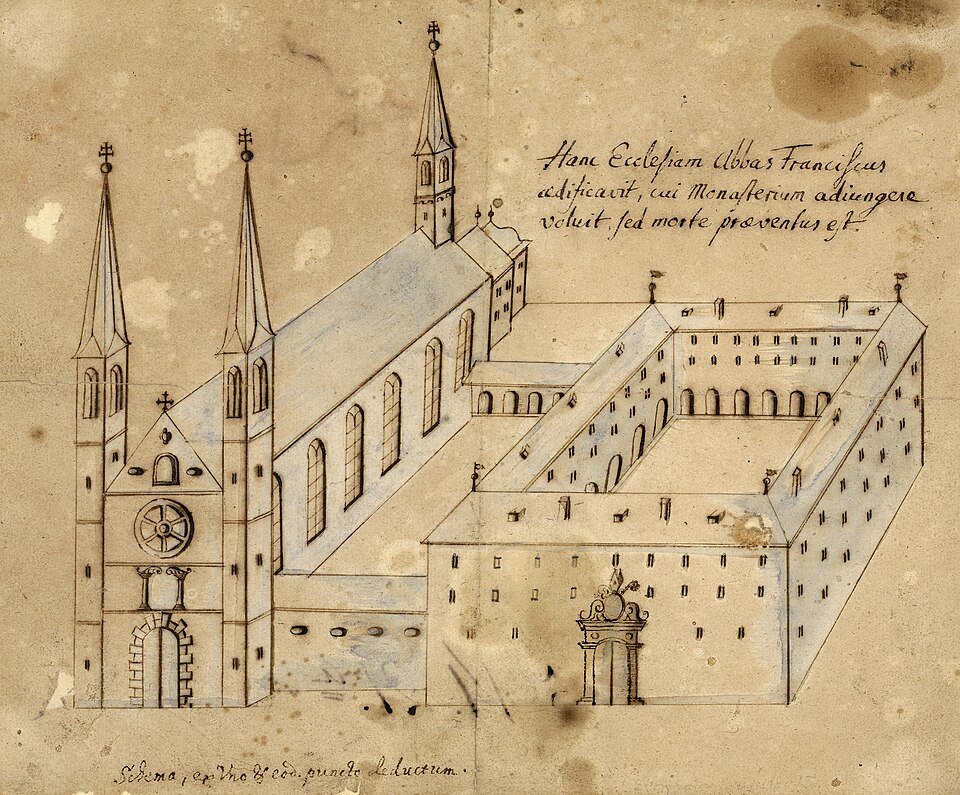


A fire had reduced the monastic church of Ettenheimmünster to rubble and ashes. The monastery lay in Baden, yet belonged at that time to the diocese of Strasbourg. The monks therefore obtained a letter of indulgence for the rebuilding of their house and sent several of their number out with the relics of Saint Landelin, founder of the original oratory that had once stood on the site of the abbey, in order to call upon the faithful for contributions and collect the gifts and dues that were offered.
So the monks travelled through the whole diocese of Strasbourg with Saint Landelin’s shrine, along both banks of the Rhine, everywhere calling people to penance and prayer and granting indulgences in return for charitable offerings for their pious purpose.
They then crossed beyond the bounds of their own diocese so as to carry their appeal into the Upper Mundat as well, a territory once attached by King Dagobert to the bishopric of Strasbourg. With the festive ringing of bells from all the churches and monasteries, the monks of Ettenheimmünster arrived at Rouffach, the capital of the Upper Mundat. Already outside the gates of the town, where the crowd had gathered to await them, they sang in ringing voices the legend and miracles of the saint whose relics rested upon their shoulders, the most precious treasure and surest safeguard of their church.
While all the people listened devoutly, fallen to their knees, a stately knight came riding wildly out of the town. Looking down contemptuously upon the simple crowd, and hearing the name of the unfamiliar saint whose wonders the monks of Ettenheimmünster were singing, he burst out laughing and hurled harsh insults at them, while urging his horse more violently through the throng.
But in that very instant his senses failed him; as though struck by lightning, he fell to the ground with broken limbs. In vain he writhed and twisted in the dust, uttering curses and blasphemies. At last he grew calmer; it seemed as though a sudden thought had shaken his soul. With hot tears he confessed and repented of his sin, begged the monks for forgiveness, and vowed to God and Saint Landelin that from then on he would abandon his former wild life and turn wholly toward heaven. At last he solemnly promised to give all his possessions to the offended Landelin as atonement for his sacrilege. And behold, immediately all his pain departed, and he rose again strong and sound as before.
The knight kept his promise: he amended his life, praised God with fasting and prayer, and gave all his property in the district of Rouffach to the abbey of Ettenheimmünster, which held it for several centuries under the name of Saint Landelin’s estate.