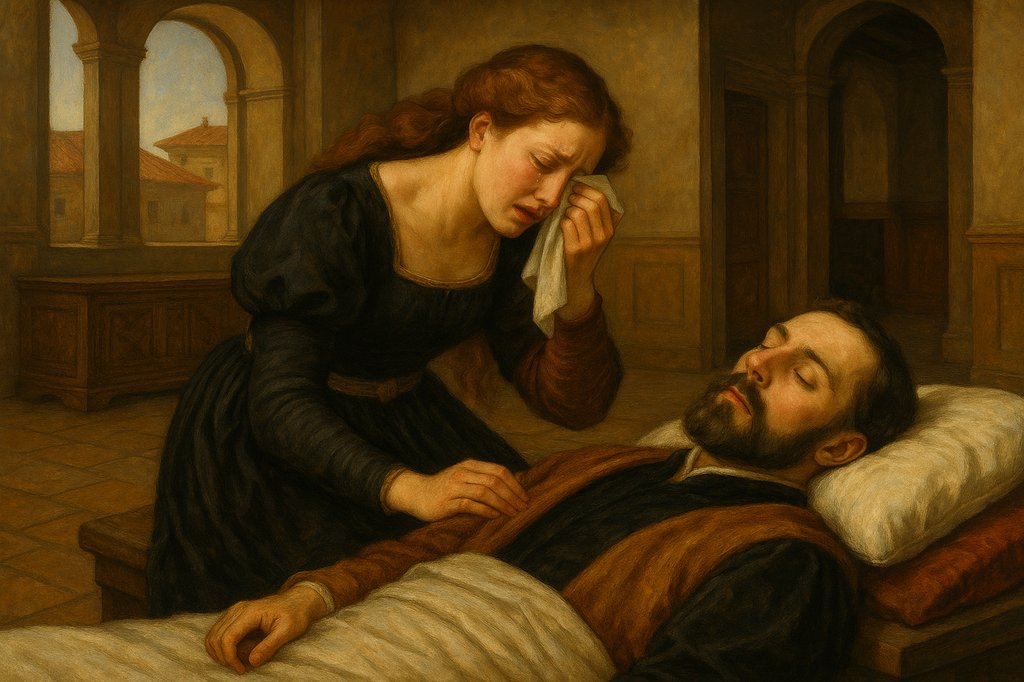


There was once a gentleman who married the most beautiful woman in Florence, all very great people of course, and they lived in the Borgo Sant' Apostoli. After one year the husband died, and the wife grieved and wailed over him so that the whole city talked of it. She wept, as the saying is, a vite tagliata, a cald' occhi-' like a cut vine' till her eyes burned. Night and day she was in grief, crying, 'I too would gladly die, and so rejoin my darling husband, who has passed away!'
O Death! why dost thou come
To those who'd live for aye?
O Death! why dost thou shun
Those who would gladly die?'
"A handsome young gentleman, a cousin of the deceased husband, was inamorato perditamente – so far gone in love with the beautiful widow that the bucket of his heart fairly slopped over, and remembering the saying that a young widow is like a log on the fire, the more she weeps the more she burns in the middle (that is to say, the more love there is in her heart), he set his wits to work to find a way whereby her love might be turned unto him.
Now Master Ludovico – such was his name – who came from Ferrara, where the people know, as the saying is, 'where to drive a nail in the right place as well as anybody,' began to tell strange tales how dead people had, when prayed to, left writing on windows like letters in answer, and how a certain man had corresponded with St. Thomas, till he judged that Signora Isabella, the widow, was well filled with the idea, as a bag of nuts; and, as he expected, she said that she would pray to her husband for such an epistle.
Then Master Ludovico, who had studied the husband's handwriting, prepared a letter purporting to be by the deceased, which read thus:
“Cara consorte, – My dear wife, I am now in the other world, and would be at peace and happy were it not that thou art in such terrible grief for me. But there is a remedy for this, for if thou wouldst fain be here with me, take my sword and kill thyself, and thy soul will at once rejoin me.
But if thou hast not resolution enough to do this, then for Heaven's sake be quiet, and stop thy wailing, and leave me in peace.
And if thou wouldst wed again, which is the most sensible thing which thou canst do, and be perfectly happy, then marry the first man whom thou shalt meet who has just been wounded by a sword, for he is destined to cheer thy life.
And keep this letter a secret until that man shall have wedded thee. THY LOVING HUSBAND."
Now the Lady Isabella had a statue of her husband, before which she prayed every day, and Ludovico put the scroll or letter into its hand. And when she read it, it was in full faith; for she was by nature one of the kind of whom 'tis said, Crederebbe che gli asini volassero – she would believe that asses can fly, if it were gravely told. So she waited for events, and sure enough, ere long, Ludovico entered, looking unusually handsome and interesting, with his arm in a sling.
I have just been having a fine time of it, che diavolo !' he said. I was attacked in the street, almost before your very door, by a rascal who whipped out his sword, and came near killing me, but I caught the point on my arm. However, he got mine in his heart.
Now, it may be noted, running on, that the proposal in the letter to Isabella-put so bluntly and unsentimentally that she should either stop crying or else kill herself, had greatly checked the current of her grief; and, as is usual with such extravagant mourners, and all people given to show and excess of emotions, she was easily turned to new fancies; and having determined that she would not make a hole in herself with the sword of her late husband, she had only to consider the only alternative of wedding the first man whom she should meet who had such a wound himself.
So, with great emotion, she bound up the wound, which was not very serious in truth, as Ludovico had inflicted it on himself with a pin, and the duel had been arranged with a friend. And then she confided to him the letter, and they were both deeply touched with the strange event, and the end thereof was that – colla sua astuzia potiede sposare la bella vedova – by his craft he won the beautiful widow, and wedded her. Moral or immoral:
Con l'arte e con inganno
Si vive mezzo l'anno,
Con inganno, e con arte
Si vive l'altra parte.
By art and trickery, I fear,
Most people live for half the year;
And by trickery and art
They get along the other part.