

One day Maiwasa of Dauan went along the reef looking for the feeding ground of a dugong (a marine mammal that grazes on algae); with him walked his wife, Bukari, a fine, well-favoured woman, possessing a notable pair of large ear-pendants (muti) ornamented with seeds (kusa). Now it happened that a Dorgai (surnatural female/spirit) named Gidzö had perched in a large tree (Dani) near by, and she cast longing glances at Maiwasa, saying to herself, "Why, that woman go along my man—that man belong to me."
Maiwasa was successful in his search, and erected a dugong platform or neět on that part of the reef where he found the grass eaten by a dugong; he spent that night on his neět, but speared nothing.
The next day Maiwasa went a long way on the reef at low water to look for marks of the dugong, and Bukari took a pat, or short simple spear, to do a little fishing.
Gidzö, taking a large drum, warup, and going to a dry place on the rocks, transformed herself into an octopus (sugu), and waited in this form for the coming of Bukari. Meanwhile Maiwasa wandered a long way off, and was so engrossed in his own business that he paid no attention to his wife's movements.
Bukari, looking in crevices and under stones in her search for fish, came at length upon the octopus and attempted to spear it, whereupon the Dorgai resumed her usual form, put her big drum completely over Bukari, and, after changing faces with her, set the unlucky woman adrift on the sea in the drum.
Gidzö then went to look for Maiwasa, who called out on seeing her, "Come on, we must go home now, the tide is rising," and Gidzö followed; when she moved or bent—"Hulloa!" cried Maiwasa, "down she broke the wind. What kind of woman is that? Bukari was not like that before." Gidzö lived with Maiwasa as his wife for some time, but though like Bukari in features, she differed from her in many details, and the sudden change in his wife greatly perplexed Maiwasa, who at length concluded that she was a Dorgai.
The warup containing Bukari drifted away towards Boigu, and was cast up on the sand beach of Baiibai, a small island close to Boigu; on stranding, Bukari came out of the drum, and looking round, saw Dauan to windward, and exclaimed, "I am a long way off from my man." On this islet there was neither food nor water, and feeling hungry, she pulled two seeds from one of her ear-pendants and ate them.
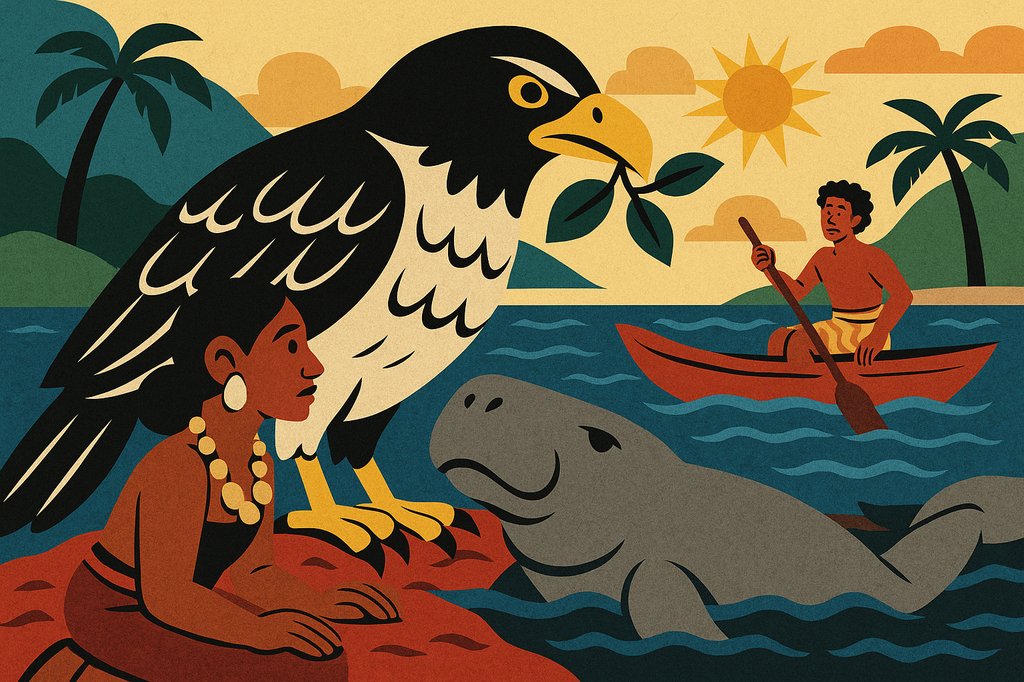
She continued to eat two seeds every morning and evening till she had finished one ear-pendant, and she wondered what she could do next, for there was no water to drink. When commencing on the second ear she discovered she was pregnant, and by the time she had eaten nearly all the seeds she laid an egg like that of the sea eagle (Nagalag). Instead of throwing it away she sat on it, and after a short time a bird was hatched, whom his mother named "Kusa Kap", or "fruit of the seeds", "as no man made him". Kusa Kap immediately but unsuccessfully attempted to fly.
When all the seeds were finished Bukari had nothing to eat and "was all bone", but soon the bird-son learnt to fly, and the first thing he did was to catch a small fish and give it to his mother, who exclaimed, "Hulloa! I have a fish now"; the bird sang out, "Go on, you eat that"; but Bukari, saying, "He no cooked", gave it back to the bird, who ate it up and then slept, as it was evening.
Early next morning Kusa Kap hulloa'ed and flew away, caught a fish, and brought it to his mother, who exclaimed, "Hulloa! got another fish now," but again refused to eat it, as it was not cooked. The bird looked at his mother, and observed that though she was "all bone" she would not eat the raw fish, but, as before, returned it to her son, who then ate it. At daybreak the bird hulloa'ed again; by this time he had grown to a large size. When out looking for fish he saw a dugong floating; he again brought a fish home to his mother, but with the same result as before.
The following day Kusa Kap hulloa'ed at sunrise; he was now grown a gigantic bird. Bukari took a piece of string and tied a small seed to his leg; he then flew away, caught a dugong, and carrying it by its claws, dropped it at his mother's feet. Bukari said, "We haven't an upi" (bamboo knife) (5); but the bird stood on the back of the dugong, cut it open with his beak, and removed the bones and viscera, and cut the meat up into small pieces. Leaving the dugong, he flew away and caught another, which he also brought to his mother, who delightedly exclaimed, "Hulloa! got another now—piccaninny along me gets big food now." Kusa Kap then cut up the second dugong with his beak as before.
Early next morning Bukari told the bird to go to Daudai (the neighbouring coast of New Guinea), to ask two of her uncles living there for some fire with which to cook, and for some water to drink, instructing him, when he found their house, to sit down close beside them, and to catch hold of a burning stick in the fire, and also of a pair of "kusu" (i.e., coco-nut water-bottles), and "when they see the seed on your leg they will know who sent you".
Away flew Kusa Kap, and all befell as Bukari predicted; the uncles filled up all their water-bottles and slung them over his wings, and gave him a bamboo knife and a burning stick (moir), which he carried in his claws and brought to his mother, remarking to himself, "Now Bukari will have a better class inside." Kusa Kap then caught another dugong which was pregnant, gave it to his mother and cut it up for her, and this time she was able to cook the meat and eat as much as she needed.
Next day Kusa Kap caught another dugong, which his mother told him to take to his uncles, and at the same time return the coco-nuts for more water. He did so, and his uncles filled up the water-bottles and gave him another upi to take to his mother. The untiring bird then caught another dugong, which he gave to the uncles; he had grown so large that he looked "all along same as island in the sky".
Next day Bukari asked Kusa Kap to go to Dauan to look after her husband, telling him, "When you see my man you sit down close beside him; he will savvy that kusa as belonging to my muti (ear-pendant); when he savvy you go, fly to canoe, catch hold of rope and mast and mat-sail; he will know you come from me and will follow you." So Kusa Kap flew off to Dauan, and all happened as Bukari expected. Maiwasa took some of his countrymen in the canoe and followed Kusa Kap in his flight. On reaching Banba, Kusa Kap flew to his mother and sat down beside her; as they neared the beach Maiwasa and his friends wondered who had killed all these dugong—the bones strewed the beach "thick like (drift) wood on beach".
Directly they landed Bukari ran up to Maiwasa, and catching hold of him, asked what woman was that who had stayed along with him. She then told him all her adventures, including the laying of the egg and the hatching of Kusa Kap, being at the same time careful to explain that "no man make him along of me". Next morning they put all the dugong into the canoe, and Bukari told Kusa Kap to go to Daudai and remain with her uncles, but added that she herself would go home to Dauan, and Bukari wept at parting from her bird-son.
The canoe then started for Dauan, but first sailed close to Saibai before making that island; on nearing the shore Bukari went aft and took a lump of wood which was in the canoe, then the sails were lowered, and the canoe was run fast on to the beach. Gidzö meanwhile was stopping in Maiwasa's house, and had no idea that Bukari had been discovered and was now returning; on seeing Maiwasa's canoe nearing shore she went down to welcome him home, but when she reached the canoe, Bukari, who had been crouching down, sprang up and killed Gidzö by a blow with the piece of wood across the bridge of her nose.