

At the close of the second and in the beginning of the third century of the Christian era, flourished the renowned King of Munster, Oilioll Oluim, from whom many distinguished families of the south claim descent. He had married Sadhbh (or Sabia), daughter to Conn of the Hundred Battles, monarch of Erin. But the actions of his life, which brought most disgrace upon Oilioll Oluim, were the violation of Áine, the beautiful daughter of Ogamuil, whom he had slain.
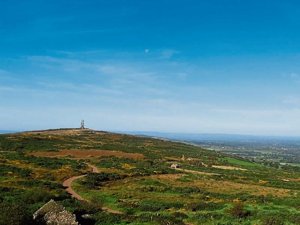
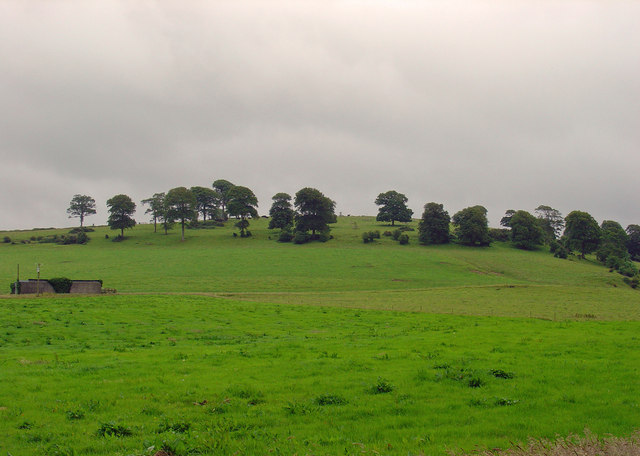
The death of Áine soon followed, and her grave was made on the remarkable elevation called after her, and now known as Knockaney, which gives name to a townland and parish, in the barony of Small County, and in the County of Limerick.
The village of Aney occupies a pleasant site on the Commogue River, and not far removed is the beautiful Lough Gur, irregular in outline, but measuring about four miles in circumference. It contains one island of about sixty acres—or rather a peninsula—connected with the eastern shore by a causeway. This is called Knock-a-dun, or the Fortress Hill; and when the Desmonds ruled supreme in this part of the country, two strong and square towers defended the most accessible points of approach on the eastern and southern sides. One of those towers is called the Black Castle.
Three or four other islets stud the surface of Lough Gur, which is surrounded by swelling hills, some of which are rocky, while others are covered with rich herbage.
However, the chief objects of interest for the antiquarian visitor are the Druidical remains on Knock-a-dun, and extending around the lake for several miles. Three singular stone circles are close to the high road leading from Limerick to Cork. From a roofless old church, on the south shore of Lough Gur, may be seen various stone circles and other massive antiquities; while a long serpentine passage between lines of huge stones leads from the lake’s margin to a tract of low ground, which is called the Red Bog.
Those remains are associated by the country people with the Tuatha Dé Danann race, and they are thought still to have relation with the enchantments of those immortal beings, who dwell in subterranean abodes.
Now, a well-known inhabitant of the place, named Donal O’Grady, happened to be returning home from a wedding party in the neighbourhood, at an early hour one fine summer morning. Considered to rank among the best pipers in Munster, his musical skill had been in requisition the whole of the preceding night, and indeed until the day began to dawn, when the merry dancers were obliged to seek their respective homes.
At intervals between the dances and songs, which he accompanied with the union pipes, Donal drained an occasional tumbler of punch and partook of other refreshments, which the pressing instances of the host, hostess, and guests rendered it difficult to decline. Accordingly, his spirits were light enough to throw energy and fantasy combined into the thrilling and lively strains of jigs, reels, and hornpipes that followed one another in rapid succession.
For his musical performances he was not only rapturously applauded, but also generously rewarded; and, at parting, all wished him a good morning and safe home.
There he might have arrived in good time; but feeling somewhat wearied as he passed the enchanted rath of Áine, and sitting down to rest for awhile, he yoked on the pipes, when, to keep his hands and elbows in practice, he struck up a joyous reel.
He had hardly commenced the first bars of “Móirín Ruadh,” than looking towards the rath, a door on the embankment suddenly opened. Out rushed a number of liveried pigmy lacqueys; and without more ado, they seized upon Donal O’Grady and his pipes. In the twinkling of an eye, they were whisked within the opening, and bang went the door, while to secure it a bolt was shot into the locker.
In mortal fear of what should become of him, Donal was hurried along the passage on the shoulders of the little men. Just at the end, another door flew open, and there a most magnificent sight met his view.
A grand hall of vast proportions, and a ceiling of exquisite beauty supported by lofty marble pillars, were lighted by a thousand lamps, which hung over the heads of a fairy throng of men and women, arrayed in the most gorgeous and fantastic costumes. Looking onwards, at the upper part of the hall, and on a throne of state, Donal beheld a lady of exquisite beauty, who wore a gold crown, all in a blaze with diamonds and brilliants, holding a reception for the crowds of tiny creatures who flocked to render her obeisance.
All were chattering around, but in a language he could not understand. However, he heard the name of Áine so frequently repeated, that he guessed the Queen on the throne could be no other personage, especially as she was the object of so much respectful greeting.
At last it was Donal’s turn to be introduced, and the master of the ceremonies, a dapper little gentleman, appeared, and led him by the hand to the lowest step of the throne.
Not willing to be deficient in manners, but also ignorant of the etiquette practised in courts, he had noticed how gracefully the fairy lords and ladies had approached and retired: the men bowing very low, and the women courtesying almost to the ground; then kissing the Queen’s right hand, and afterwards backing out with repeated bows and courtesies, until lost behind the groups still advancing.
However, fearing he might too awkwardly imitate those court manoeuvres, when Donal O’Grady appeared before the throne, taking off his straw hat with the left hand, and pulling down the front lock of hair on his forehead with the right, he gave a quick jerk with the right knee, bending the left—and in such a fashion as made the fairy courtiers giggle and titter.
Donal was not a little annoyed at these indications of what he thought to be bad manners; but when the Queen graciously held out her hand and smiled benignantly, he also kissed it, and all his rising resentment was quickly appeased—especially as Áine said something in fairy language to the High-Chamberlain, and pointed to the pipes of Donal O’Grady, which during the presentation he had slung over his shoulder.
Soon the Master of Ceremonies waved a white wand, when all the fairy lords and ladies retired to the elegant cushioned seats prepared for them. Making a signal to Donal, he was led to a chair. Then the pipes were removed from his shoulders, and placed on his knee.
He understood what was required of him; and observing the Queen giving her hand to some favoured gentleman, while other fairy lords began to select their partners, Donal set the pipes in motion.
Finding the couples ranged in two long lines, he supposed they desired to have a sprightly country dance. He began to think what tune he might best select for their gratification. At last, Donal deemed the “Fairy Dance” not inappropriate.
The moment he began to play, nothing but glee and merriment passed along the vis-à-vis lines of ladies and gentlemen. The Queen and her partner with the foremost couples led off, and soon the mazes of the dance were executed by the various couples in succession, to the evident delight of the performers, and to the great admiration of their musician—as afterwards he narrated this unique experience in his life.
Donal observed, that all the fairy gentlemen he saw there, although finely dressed, were little wizened creatures, their faces old-looking, covered with wrinkles, and ugly as sin; while their bodies and limbs were for all the world like those of “Daddy Long Legs,” the beetle or cockatrice so well known to the country people.
In like manner, the ladies, in the matter of charms, greatly resembled their lords—all, with the single exception of Queen Áine, who was the greatest beauty Donal’s eyes ever beheld.
Having danced a variety of jigs and reels, alternating with the country dances, all seemed to be well satisfied. At a signal given, the Queen and all the dancers then filed before Donal O’Grady, with smiles of approval and with graceful salutes. Afterwards they suddenly vanished, and the lights were all extinguished.
The imprisoned piper was then left alone in complete darkness, and there abandoned to his own disconsolate reflections.
Willingly would Donal make his escape from his subterranean prison; but on groping about, he could not find that passage through which he had been carried. Moreover, he knew that even if it were discovered, the bolt and lock had been too fastly secured to admit of outlet through the door by which he had entered.
Hours had passed over in this forlorn state. After some time, however, he could observe the fairies flitting through the hall, and jabbering to one another, but he found it was not Irish—which he could understand—that they spoke.
At last, all the fairy men seemed to congregate in military array, and mounted on tiny steeds, as if bent on some outdoor expedition. A dim light began to open also on their movements. Donal saw the chief draw out at the head of his cavalcade and approach the door, through which himself had been ushered into that apartment. Then raising his sword, the fairy leader shouted out:
“Tatther Rura!”
and every one of his warriors repeated:
“Tatther Rura!”
Immediately the door opened; all rushed out through the passage. The door again closed behind them.
The imprisoned piper had now learned the fairies’ password; and when their sounds were lost in the distance, he also cried out:
“Tatther Rura!”
The door at once opened, and the passage was found to be clear to the outer entrance, the cavalcade having disappeared, and bound on their distant expedition.
Again Donal shouted “Tatther Rura,” and the door flew open, so that he was enabled to rush out, and gaze once more on the scenes around Knockaney. He deemed it thus fortunate to have learned the meaning of two words of the Tuatha Dé Danann or fairy language, and which were of such practical utility to him.
Gathering the pipes under his arm, he joyfully hastened homewards.
For many a long day, Donal O’Grady was enabled to narrate his extraordinary presentation to Queen Áine and her courtiers, on the frequent recurrence of fairs, christenings, weddings, and country parties, where his admirable chanter performances were in such general requisition.