

In the days of Blessed Willibrord there was a young man from Echternach named Veit who, because of his extraordinary height, was called “Veit the Tall”. He had only recently converted to Christianity and had gone on pilgrimage to the Holy Land with his young wife, who had likewise become a Christian.
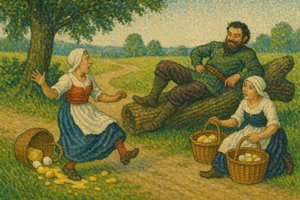
Ten years had already passed since their departure, and as no news of them had reached Echternach, their relatives, believing them to be dead, divided all their goods among themselves. Great, then, was their astonishment when, on Easter Day in the year 729, Veit the Tall suddenly reappeared in Echternach. But sorrow lay upon his otherwise cheerful face: his dearly beloved companion had been murdered by the Saracens. Poor, he returned home with nothing but a strange instrument unknown to everyone, a kind of fiddle.
When Veit asked for his property back, his relatives decided to accuse him of having murdered his wife. The next day they brought their charge publicly, and three of the strongest among them offered, according to the custom of the time, to prove the truth of their accusation by single combat.
On Whit Monday the combat took place. At the very first bout Veit was thrown to the ground, and with his opponent’s foot on his throat he was forced to declare himself defeated. Thus he was found guilty of murder and condemned to be hanged on the following day.
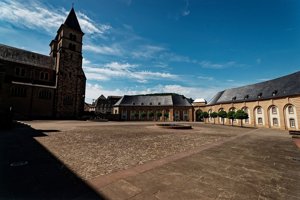
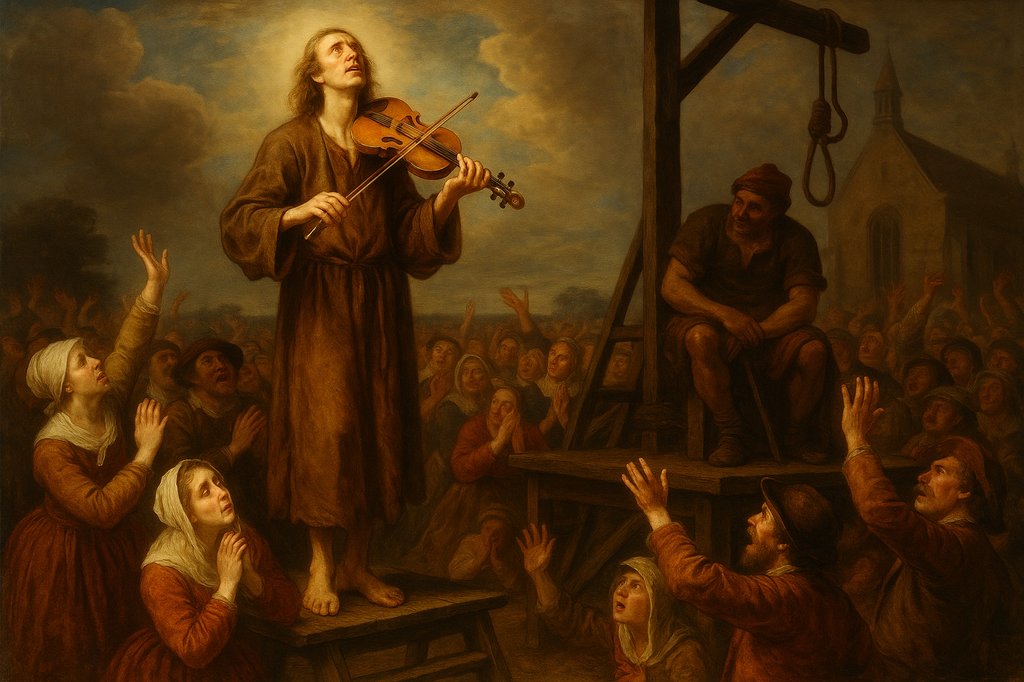
Veit begged as a last favour to be allowed to take his fiddle with him on his way to death. Soon he was already standing on the ladder, at the foot of the hill where the parish church stands today; the gallows was surrounded by a great crowd of onlookers.
Then Veit seized the bow and drew from his fiddle such clear, ringing notes that the crowd, amazed and deeply moved, pricked up its ears. After the first tones of lament, the marvelous instrument sounded like sobbing and tears, so that the people were beside themselves, wringing their hands and casting about them wild, bewildered glances.
The hangman, who was standing at the top of the ladder, swayed, let the fatal rope fall from his hands, and, no longer able to keep his place, stumbled down in confusion.
Meanwhile Veit played on and on. Under his light, swift-moving bow, sparks seemed almost to leap from the strings, and the crowd all around, rooted to the spot, was completely under the spell of the mighty fiddler, who suddenly conjured forth gentler, heavenly chords: it was a prayer rising from the enchanted instrument up to heaven.
The spectators fell to their knees. Veit’s lips moved; he was praying, and tears flowed from his great blue eyes, raised to heaven. God heard the poor fiddler’s prayer, turned His face away from the guilty crowd, and delivered Veit’s accusers into his hands.
Then suddenly, seized by wild inspiration, Veit drove his bow furiously over the strings, and leaping, irresistible tones rang out, casting their spell far and wide. As though lifted by an invisible hand, all the people sprang to their feet and began to move in dance—at first calmly and measuredly, then ever faster and faster, until at last everything whirled about in a frenzied dance.
Men and women, old folk and girls, fathers and children, all danced. Veit’s relatives, and with them their nieces, danced around the ladder; the hangman danced beneath the gallows. The animals hurrying home from the pastures began to dance as well. Everything that lived in and around Echternach was seized by the madness of the dance.
Still playing, the fiddler climbed down from the ladder, walked through the crowd—which, unable to stop him, could only continue to dance—and slowly moved away. For a while one could still hear the tones of the magic fiddle sounding from afar; but Veit himself had vanished, and he was never again seen in those parts.
All Echternach danced until sunset; but Veit’s eighteen relatives, so the legend says, danced without ceasing for a whole year around the ladder. They had already danced themselves into the ground up to their knees when Blessed Willibrord in Utrecht heard of it, hastened quickly to Echternach, and released them from the enchanted dance.
After J. Collin de Plancy, printed in the Luxemburger Zeitung, 1858, no. 121.