
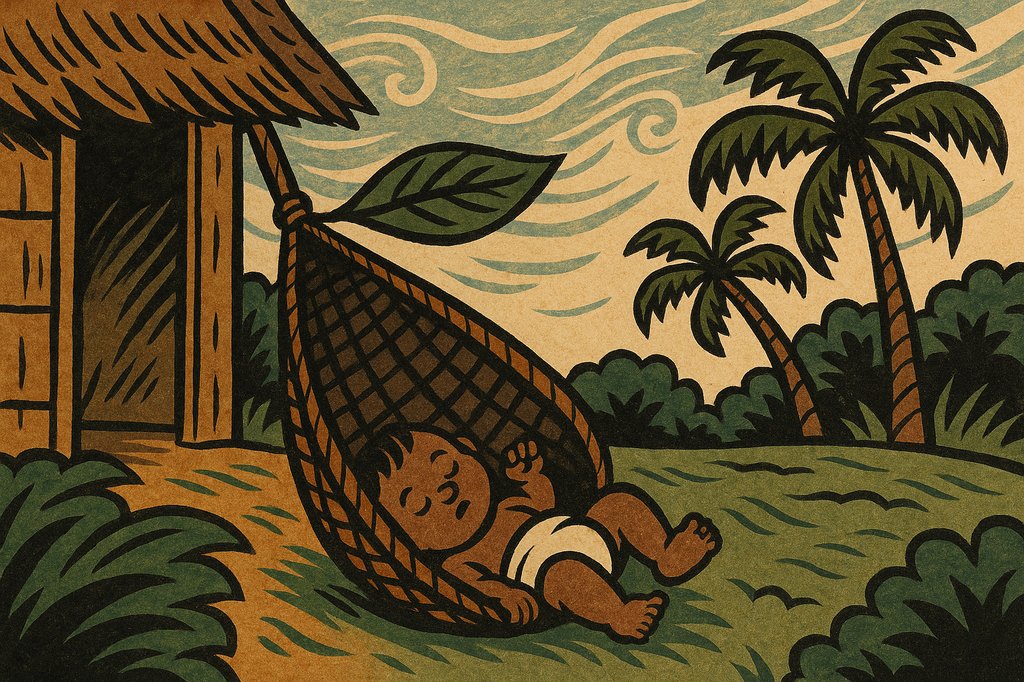


Once upon a time a baby-boy named Upi lived in Badu. One day his mother, wanting to go into the bush to make her garden and not wishing to take Upi with her, put him in a basket, which she hung up in the house near the open door. A strong south-east wind was blowing, and after some time had elapsed a gust of wind blew down the basket and carried it outside the house on to some grass, and Upi rolled out. As the mother was digging she broke the stick used for that purpose, and at once she thought something amiss. "I leave my boy," she spoke to herself; "good, I go look, perhaps someone he take him." So she returned home, to find neither basket nor baby in the house. Crying all the while, she searched far and near outside the house, but could not find her boy; for it had so happened that a man and his wife had passed that way and taken the child.
The man, as usual, was walking in front, followed at a short space by the woman, when the former heard Upi cry. "What name that make a noise?" he exclaimed. Twice he heard the cry, but his wife heard nothing. On looking about he found Upi, and called out, "Hulloa! boy there in grass," and close by he found the basket, and putting Upi inside, the latter said to his wife, "You come along; I find boy belong you and me". Thus, having no son of their own, they adopted this one—"they sorry for boy."
The man and his wife returned home with Upi, but before they entered their house they left the baby in the bush. The man said, "By-and-bye night he come, we go and take that boy."
The next morning they told the men of their village that they had found a boy, and the man carried Upi about to show him to them. Two noted warriors, Manalboa and Sasalkadzi, said, "All right, you take him, we look." Later on they said, "We go play." Then they stuck two posts into the ground a foot or so apart. When this was done they said to the father by adoption, "Give we boy first we spear him." "No, I won't give you fellow, I take him back to the house." To which the two men replied, "S'pose you no give to we, we fight you." So the man was forced to give up the boy; but he and his wife enjoined them, "No good you spear eyes and belly, you spear arms and legs." The men made fast an arm and leg of Upi to each pole, and after spearing him they went into the bush to get some food. In the afternoon they again practised javelin-throwing at the luckless Upi, who remained tied fast to the posts all day and during the night. He, however, thrived well in spite of the treatment he had received, and grew amazingly.
Next day the men went to the bush, and on their return in the afternoon took their javelins and throwing-stick and again amused themselves with Upi for a target. The foster-parents prayed the men, "No take large spear, take small one." The boy cried. That night the man and his wife took Upi away and washed and fed him, but tied him up again.
In the morning the men once more played and speared Upi; at noon they went into the bush, but in the afternoon they cast their javelins at the boy. Afterwards the foster-father went to have a look at Upi, who by this time had grown up into a big boy; the latter said, "You take rope off me, when you sleep I will go away." The man did so, and when all the men slept the boy went.
Whilst running through the bush Upi came to a small house, and, entering it, found two corpses (inerkai) inside. He took their skulls, washed them, and put "bushes" on them, and placed them together on one side and spoke to them, saying, "All men spear me, you two give me good road". They told him to go in a certain direction, where he would find a particular kind of bamboo (upi) growing. He was to go up to it and kick the base of the stem with his heel, and the bamboo would split, and he was to go inside the bamboo, and "by-and-bye upi sorry for you." Upi replied, "All right, you two finish telling me? I go now"—"him, he go." All happened as the skulls had foretold, and after entering the bamboo Upi came out again and made a fire close by.
The men at the village looked round the next morning, and, finding Upi had vanished, told his adopted parents that they suspected them of taking him away, to which they replied, "We no take him out, he did it himself." The men took their bows and arrows and went into the bush to look for Upi. They tracked him by the blood-spots to the house where the dead bodies were; on going inside they saw that the skulls had been used for divining, and resuming their search for Upi, they ultimately found him.
Manalboa and Sasalkadzi said to Upi, "You see us, we kill you." "All right," replied Upi, "you two kill me." All the men came close. Upi struck the bamboo, went inside, and it closed up. The cane then jumped about, and its leaves "fought" all the men and killed them; no man went home. The boy Upi remained passive inside; the bamboo upi did it all. The bamboo stood up, the blood from the slain men ran down its leaves and dripped into a couple of melon-shells (Cymbium) which were on the ground. The bamboo upi jumped up again, took the skin off all the men and put them in the place, and, cutting off their heads, deposited them close to the base "head" of the bamboo upi. The leaves swept away the bodies of the men. To this day bamboos grow in clear spaces, with no bushes beneath them.
(I have something in my notes here about Upi getting outside the bamboo, and all the Dorgai coming and wanting to kill him, and a round house with a central post was mentioned, but this part is now illegible; round houses are characteristic of the Eastern tribe.)
The remaining men of the village went to look for Upi, and said to him, "You fight men belong to us?" "Yes," he replied, "I been fight them fellow," and he re-entered the bamboo, which jumped about and fought all the men, and the Dorgai too. "No one go home, all he dead." Upi still remained passive within the bamboo while the blood was again collected.
When Upi came out he returned to the skulls and told them what had happened, and asked them, "What you say, finish?" "All right," they replied, "finish. You go and split all the upi, by-and-bye the women will come, you take them all, they belong to you." When he had finished cutting up all the bamboos the women came, and he took them all and went home and told his foster-father, "You take all them women and put in your house, then you come on; we two go and look for my mother."
They went to Upi's mother's house, and found that she was away in the bush making her garden, but they remained in the house, closed the entrance, and pretended to be asleep. When the mother returned she put down her basket outside and looked at the doorway and said, "Who shut my house?" She removed the obstruction and entered her house. Upi looked up and said, "You my mother?" She said, "What your name?" "My name Upi." His mother caught hold of him and cried, and told Upi, "I been look round before, no find you; I could not cry, that my throat he fast." Upi said that they had come to take her to another house.
They looked at a house in the other village and decided to live there. Upi gave all the mothers among the women whose husbands had been killed to his foster-father, but kept all the girls and young women for himself.