


SOON after Saint Columba established his residence in Iona, tradition says that he paid a visit to a great seminary of Druids, then in the vicinity, at a place called Camusnan Ceul, or Bay of Cells, in the district of Ardnamurchan. Several remains of Druidical circles are still to be seen there; and on that bay and the neighbourhood many places are still named after their rites and ceremonies, such as Ardintibert, the Mount of Sacrifice, and others.
The fame of the Saint had been for some time well known to the people, and his intention of instructing them in the doctrines of Christianity was announced to them. The ancient priesthood made every exertion to dissuade the inhabitants from hearing the powerful eloquence of Columba, and in this they were seconded by the principal man then in that country, whose name was Donald, a son of Connal.
The Saint had no sooner made his appearance, however, than he was surrounded by a vast multitude, anxious to hear so celebrated a preacher; and after the sermon was ended, many persons expressed a desire to be baptized, in spite of the remonstrances of the Druids.
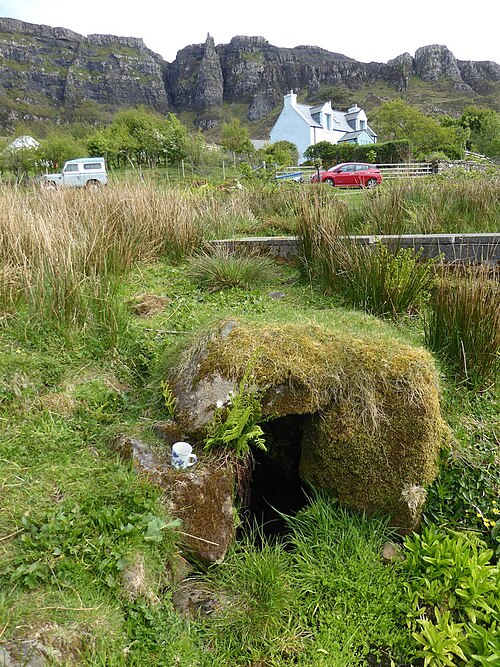
Columba had made choice of an eminence centrally situated for performing worship; but there was no water near the spot, and the son of Connal threatened with punishment any who should dare to procure it for his purpose. The Saint stood with his back leaning on a rock; after a short prayer, he struck the rock with his foot, and a stream of water issued forth in great abundance.
The miracle had a powerful effect on the minds of his hearers, and many became converts to the new religion. This fountain is still distinguished by the name of Columba, and is considered of superior efficacy in the cure of diseases. When the Catholic form of worship prevailed in that country it was greatly resorted to, and old persons yet remember to have seen offerings left at the fountain in gratitude for benefits received from the benignant influence of the Saint’s blessing on the water.
At length it is said that a daughter of Donald, the son of Connal, expressed a wish to be baptized, and the father restrained her by violence. He also, with the aid of the Druids, forced Columba to take refuge in his boat; and the holy man departed for Iona, after warning the inhospitable Caledonian to prepare for another world, as his life would soon terminate.
The Saint was at sea during the whole night, which was stormy; and when approaching the shores of his own sacred island the following morning, a vast number of ravens were observed flying over the boat, chasing another of extraordinary large size. The croaking of the ravens awoke the Saint, who had been sleeping; and he instantly exclaimed that the son of Connal had just expired—which was afterwards ascertained to be true.
A very large Christian establishment appears to have been afterwards formed in the Bay of Cells; and the remains of a chapel, dedicated to Saint Kiaran, are still to be seen there. It is the favourite place of interment among the Catholics of this day.
Indeed, Columba and many of his successors seem to have adopted the policy of engrafting their institutions on those which had formerly existed in the country. Of this there are innumerable instances: at least we observe the ruins of both still visible in many places; even in Iona we find the burying-ground of the Druids known at the present day. This practice may have had advantages at the time, but it must have been ultimately productive of many corruptions; and, in a great measure, accounts for many superstitious and absurd customs which prevailed among that people to a very recent period, and which are not yet entirely extinct.
In a very ancient family in that country two round balls of coarse glass have been carefully preserved from time immemorial, and to these have been ascribed many virtues—amongst others, the cure of any extraordinary disease among cattle. The balls were immersed in cold water for three days and nights, and the water was afterwards sprinkled over all the cattle; this was expected to cure those affected, and to prevent the disease in the rest. From the names and appearance of these balls, there is no doubt that they had been symbols used by the Archdruids.