


There once lived in Florence, in the Via Condotta, a gentleman who had a great love for all manner of antique and curious things, and who was also devoted to music.
And by much reading and reflection he had come to believe that the music of ancient times must have been far better than that which we now have, because, as all the other arts were more perfect, that also must have been. (Which thing, if it be true in everything, makes it a great pity that we are not all a thousand years behind the time.)
However, everybody did not agree with him as to this, and among these was a friend, who well understood that though two, blowing at a candle, put it out, yet that a pair putting wood on a fire make it burn the more. So between them they made the fire of controversy blaze up merrily enough. And one evening they raised it to burning heat, the friend of the antiquary affirming that he believed the music of the ancients was all rubbish, scrannel-piping and cat-calls, penny trumpets and child-rattles, while the other swore it was like the holy chorus of angels, with Santa Cecilia as first violin or capo d'orchestra.
At last the advocate of modern music declared he would bet a hundred crowns that he was in the right, and his friend accepted the wager. Now, truly, this seems very much like laying a bet that there is another world, or ghosts; but the antiquary was equal to the occasion, declaring that he knew a wise magician who by his art could settle the question.
Then going to the sorcerer, who dwelt near by Santa Croce, he told him all, saying that he, the magus, might keep the hundred crowns, and welcome, if it could only be proved that the music of the olden time was superior to that of these our days.
"Tis a difficult thing to prove," replied the wizard- " difficile ma non impossibile – but though 'tis hard, 'tis not impossible ; and thou art in the right - per Bacco ! – the ancient music truly was the best.
“Ebbene, io ho il vostro affare – Well, I see my way to it! " he cried after a short reflection. "I know where, in a ruined temple not many miles away, there is an antique statue of a girl holding in her hand a lyre, and we will go thither this night and see what can be done."
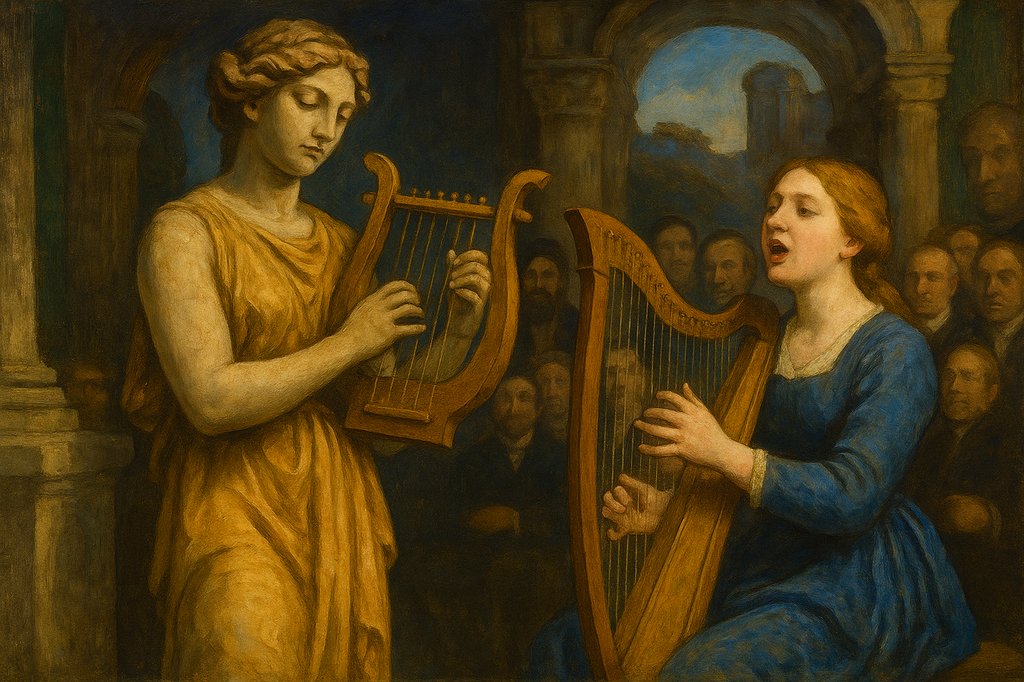
So they went secretly, and at midnight the sorcerer enchanted the statue, so that it became a living woman of extraordinary beauty, who played and sang with such exquisite charm and skill that the antiquary found all he hoped for far surpassed.
Then he took the lady to his home, and next day said to his friend:
"Now we will settle that wager of a hundred crowns, and I care not if thou wilt make it for a thousand. And this is what I propose: do thou bring the best female singer and musician, be it with the lute or harp, whom thou canst find, to perform in modern style, while I will produce another, who will do the same, al antico modo in the ancient manner."
Now, both being distinguished men, this proposed competition or trial caused great excitement, and on the day appointed for the strife all the distinguished people of Florence, including the musicians, were present.
Then the lady who represented modern music sang and played the harp. All were delighted, and applauded her, declaring that it was not possible for art to surpass what they had heard.
But when she who had been the statue appeared, there was a dead silence of admiration; nor were the auditors less silent while she sang and played, nor even for a minute after she had ceased, so spell-bound were they by the charm of her voice and the infinite depth of her skill, which was supported by the genius of the composition, as the colour of a great picture is supported by the design. But when the charm was broken, all applauded as they had never done before, declaring that the ancient music surpassed the modern as the sun in light surpasses a star.
Now there was present another and a rival magician, who well understood the whole affair; and, whether it was for a jest or to annoy his rival, he rose and said to the singer:
"Thou hast sung so well that it seems to me we really ought to erect a statue to thee in thy honour; and as none but thyself can be thy parallel, or honour thee as thou deservest to be, I will even make thee a votive image unto thyself, O Muse!"
"Saying this, he touched her, whereupon the beautiful singer became at once a statue as before."