

After Gallus had recovered his health at Arbon through the grace of Christ, it soon became clear that divine Providence had preserved him for higher purposes in the German lands. He therefore turned to the deacon Hildibold, Willimar’s faithful companion, who knew the surrounding country better than anyone else, and asked him:
“My son, have you ever found, in this desolate wilderness, a place suitable for building a house of prayer and a dwelling for me? For my heart longs for solitude, as the psalmist says: ‘I remained in solitude and waited for the one who would restore me to health.’”
The deacon replied:
“My father, this wilderness is harsh and filled with mighty waters. It abounds in high mountains and narrow valleys, and in all manner of wild beasts: there are very many bears, wolves and wild boars. I fear they might fall upon you if I were to lead you there.”
But the man of God answered:
“If God is for us, who can be against us? He who saved Daniel from the lions’ den is also powerful enough to deliver me from the claws of wild beasts.”
When the deacon Hildibold saw that his resolve was firm, he said:
“Then tomorrow we shall venture into the hidden depths of the forests and see whether we may find a suitable place.”
The man of God spent the rest of the day in his customary prayers and took no food. Early the following morning, the two men set out, praying as they went. The ninth hour of the day had already passed when the deacon asked the holy man whether he wished to take some refreshment. But Gallus replied that he would eat nothing until he had found the place where he could establish his dwelling.
So once more they forced their weary limbs onward, until at last they came to a little river called the Steinach by the local people, at the place where the water plunges down from the mountain and has hollowed out a cavity in the rock, now called the Mühletobel. There they decided to rest for the night, especially since many fish could be seen in the water. A net brought by the deacon was lowered into the stream, and a considerable number of lively, glistening fish were caught.
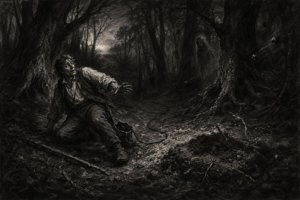
Hildibold kindled a fire and prepared a refreshing meal. Meanwhile, the man of God had been looking for a place where he might kneel and offer his customary prayer. Then his foot struck against a thorn bush; he stumbled and fell to the ground. The deacon hurried towards him and tried to help him rise, but Gallus spoke in the words of the psalmist:
“Leave me! This is my resting place for ever. Here I shall dwell, for this place pleases me well.”
When he had risen from prayer, he made a cross from a hazel branch and fastened to it a small case containing several relics he had brought with him. Then the two men prayed together with one heart, and Gallus humbly pleaded:
“Lord Jesus Christ, who through the victorious sign of the Cross hast brought salvation and help to humankind, grant that this land may become habitable to thy praise and glory!”
By then evening had fallen, and they ate their meal with thanksgiving.
Afterwards, both men lay down to rest. Before long, however, Gallus rose again and knelt before the cross in fervent prayer. His travelling companion listened secretly and from time to time tended the glowing fire. Suddenly, a bear came down from the wooded mountains, trotted towards them and devoured the remains of their meal. Hildibold lay there in fear and trembling, not daring to move.
Gallus, however, rose from his prayer, stepped before the bear and said:
“Wild beast, in the name of Jesus Christ, I command you: take wood and cast it into the fire!”
At once the bear turned away. It returned standing on its hind legs, dragging a mighty log, and laid it in the fire. As a reward, the man of God gave it a piece of bread, which the bear ate with a contented growl.
Then Gallus said to it:
“In the name of Jesus Christ, my Lord, depart from this valley! Let the wilderness of the open mountains and hills be your domain; but here you shall harm neither livestock nor human beings!”
The bear ran off, vanished into the forest and never returned. In memory of this wondrous event, St Gall still bears an upright bear on its coat of arms.
His travelling companion, who had witnessed everything, rose, threw himself at the saint’s feet and cried:
“Now I know that the Lord is with you, for the bears of the wilderness obey you!”
But Gallus forbade him to kneel before him or to tell anyone a word of what had happened until he had seen greater miracles. And indeed, as the pious legend relates, such wonders were not long in coming. Following the legend, we shall relate one more of them to the reader.
When morning came, the deacon said:
“Lord, what do you wish us to do today?”
Gallus answered:
“Let us remain here for this day as well. Take the nets and go to the whirlpool. I shall follow you shortly.”
So Hildibold rose and went to cast the net. Suddenly, two evil spirits appeared before him in the form of women. They hurled stones at him and said:
“Why have you brought that man into our wilderness? He is unjust and overpowering!”
Trembling, the deacon ran back to Gallus and told him what had happened. The saint strengthened himself through prayer, went with his companion to the whirlpool and cried:
“Spectres, in the name of the triune God, I command you: depart from this place and never return here again!”
At once the spirits fled, wailing and howling, farther and farther upstream along the riverbed, until they disappeared. While the men drew the net full of fish from the water, they could still hear the fading voices of the female fiends.
Later, when the deacon Hildibold had gone out to catch hawks, he heard an unseen voice call down from a mountain:
“Is Gallus still in the wilderness?”
And when he cried loudly and firmly into the forest:
“Yes, he is there, and there he shall remain!”
he heard only a growling and whimpering sound, which gradually faded into the distance.
Gallus and Hildibold now searched valley and mountain, and nearby, between the two streams called the Steinach and the Ira, they found a wood and a pleasant plain. It was a place inviting the building of a cell. There were indeed many snakes there; but at the saint’s prayer they disappeared and were never seen again.
Dr G. Klee, after the Vita St. Galli. Diener des Kreuzes, Stuttgart, Steinkopf, 1900.