


The name “San Caja” is significant, though its meaning is in dispute. Some people who should know say that it means Holy, or Sainted, Box; that the word caja, meaning box, alludes to the chest, or chests, of treasure hidden in the mountain. But a white man native to the San Caja country told me that a very old Mexican once told him that the name was originally Sin Caja, sin meaning without, and caja also meaning coffin; hence, Without Coffin. According to the Mexican, the name was derived from the fact that a man had once been buried on or in the mountain without a coffin—perhaps not buried at all, but left out in the open. Either interpretation is appropriate to the legends of the mountain.
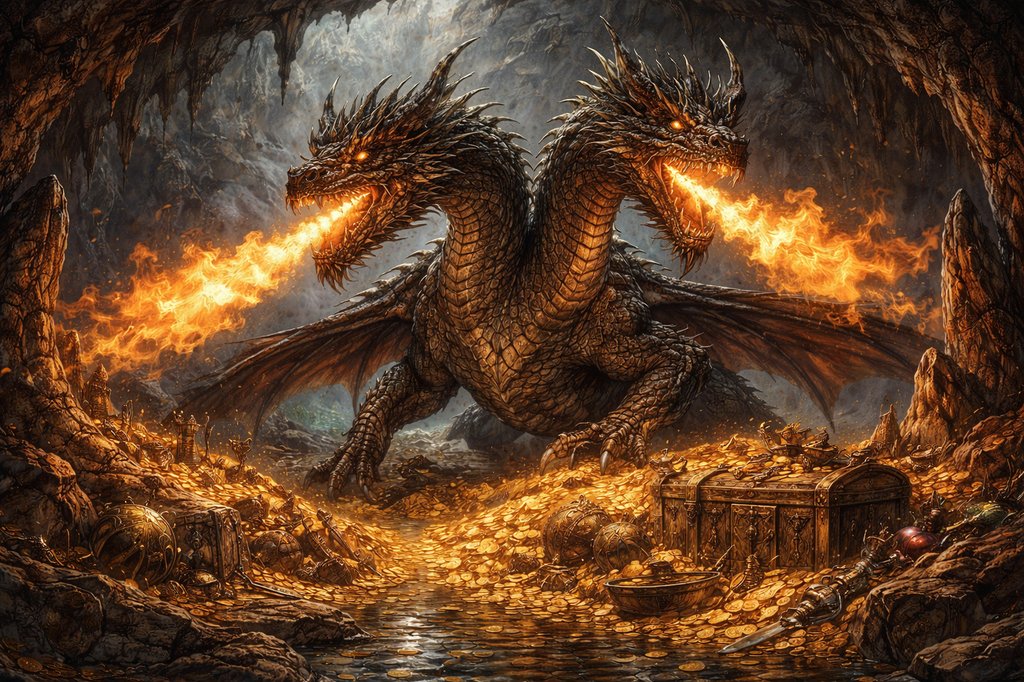
Under the mountain is a cave, the entrance to which is on the west side halfway up the slope. Mexican bandits who preyed on the wagon and mule trains that traveled the San Antonio-Laredo road were accustomed to ride their horses into that entrance. They had a great room underground that they used for a stable. Back of it was their treasure room, el apartado del tesoro, in which were heaps of gold and silver coins, Spanish doubloons and old Mexican square dollars, golden candlesticks, silver-mounted and jewel-studded saddles, bits and spurs of precious workmanship, plated firearms, all manner of costly plunder meant for grandees and cathedrals, as well as bullion from mines nearby—for there were rich mines in that country in the old days of the Spanish.
According to Mexican tradition, after the bandidos had accumulated all this treasure, a terrible dragon came and killed some of them and drove the others away. The dragon had a spiked tail and two heads, and at night one might see fire flashing from his nostrils. He came to be called el celador del tesoro—the warden of the treasure—and there are Mexicans today who would not think of violating the place that he still guards.
An addition to the legend was told me by Mr. Whitley. Years ago, so he had heard, a certain white man who bore the marks of a borderer was visiting the penitentiary at Huntsville when he suddenly heard himself addressed in Spanish. He paused. At his side appeared a Mexican, begging to speak with him. The guard consented, and then, in his own language, the Mexican poured out his tale.
He was serving a life sentence in the penitentiary, the sole survivor of a band of murdering brigands. All their booty was still in a cave to the south of San Caja. If the white man would recover it, he might have half, using the other half to free the prisoner. He gave directions about as follows: Go to the southeast side of the mountain; thence go about a mile to two little knobs, then on down a kind of ravine about the same distance, where an opening will be found that leads into the booty hall. The white man set out to follow the directions, but he was already old, and death overtook him before he could search out the treasure.
“There are,” says Mr. Whitley, “two knobs on the southeast side of the mountain, but two miles down instead of one, which shows that a Mexican has no sense of distance. In giving directions he always says un pedacito—a little piece—which may mean a half mile or five miles.” Anyhow, the country does not seem to fit the Mexican’s measurements.