

Once upon a time a man named Sesere lived by himself at a place called Seserenegegat, in the island of Badu. One day Sesere took his bow and arrow, and went on the reef at low tide to look for fish; walking along, he came to that portion of the reef which was opposite to the village of Tul, and there he found a pool containing numerous fish, all of which he shot. The men of Tul, envious of his success, came up to Sesere and demanded why he did not stop in his own place instead of encroaching on their reef. Then they took the fish away from him, broke his bow and arrow, flinging the pieces away, and, catching hold of his head, pushed him along. Sesere returned home.
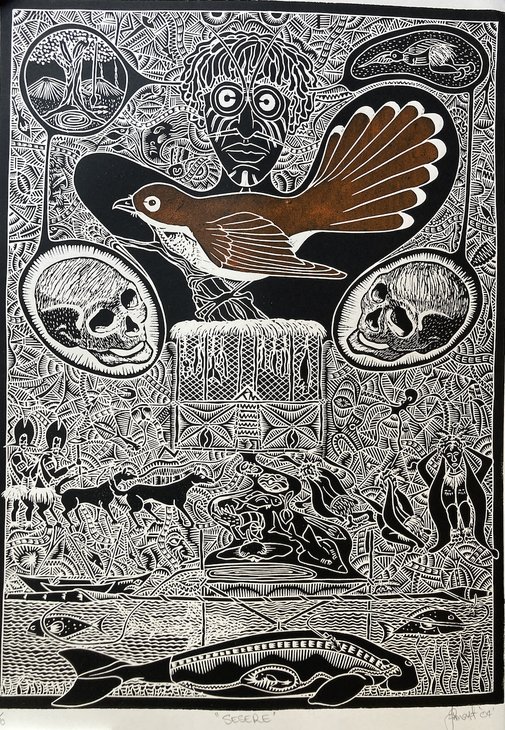
Next morning Sesere again took a bow and arrow and went to the same pool in the Tul reef, and shot plenty fish. Once more the Tul men attacked, robbed, and drove him home. Later in the day he walked on the reef, talking and grumbling to himself; looking about him, he noticed that the grass-like plant which grows on the reef had been bitten so cleanly as if cut with some sharp instrument, and he fell to wondering what fish had eaten the grass, and whether that fish was fit to eat. "I don't know what name—fish he kaikai?" That evening Sesere went into the bush and picked a quantity of scented leaves, with some of which he thoroughly rubbed the skulls of his father and mother, and on the remainder placed these relics of his departed parents. Then he lay down with the skulls close to his head, but before he went to sleep he told them what had befallen him on that and the previous day, and inquired what fish it was that ate the grass, and how he could catch it.
When he slept the skulls made a small noise, and spake to Sesere, informing him it was the dugong which ate the grass, that it was good to eat, and that if he wanted to catch it he must take six pieces of wood and stick them on the reef where he had seen the marks of the dugong, for it would return to its feeding ground until all the grass was eaten. Three poles were to be erected to windward and three to leeward, they were to be well lashed together, and the steering-board of his canoe was to be tied on to the top. When this was finished he was to go into the bush till he came to a tree on which a Topi bird was perched and making its noise. There he would find a harpoon and rope. These he was to use for harpooning the dugong when it returned on the following night. As soon as the skulls had finished talking Sesere pushed them aside, saying, "Go, you two, you give me bad word"; then he said, "Come on," and, putting them back again, "You speak good word." Nothing further transpired, but Sesere did not go to sleep again; he waited till "small daylight", and when the wild-fowl called out he started for the bush, where he found the dugong-harpoon and two pieces of rope, to one of which a dart was affixed.
Further following out his instructions, Sesere constructed the platform, and at night sat on the top of it waiting the arrival of the dugong. In due time it came, and Sesere successfully harpooned it. Leaving the harpoon with its rope on the platform, he hauled the dugong to the beach by means of the spare rope, where he cut it up, and the method of carving a dugong which he then originated has been followed ever since. The platform, or neet, is still erected according to the plan revealed to Sesere by the skulls of his parents. After he had cut up the dugong with his bamboo knife (upi) he cooked some of it in an earth-oven (arnai), and some he boiled in a large conch-shell (bu, Fusus), using a small clam-shell (akul) as a spoon.
Next day Sesere reconstructed the neet in another place, further out from the shore than before. The Tul men saw him and wondered what it was. At sundown Sesere mounted the neet, taking some dugong meat to eat while waiting. At high water a dugong came; Sesere harpooned it and dragged it on to the beach; he returned to the neet, ate some more food, stood up, and soon killed another dugong. Then he thought he had enough food, as a male and pregnant female had succumbed to his harpoon. He cooked some meat on the beach and slept. At daybreak he smoked a large number of pieces of meat over his fire and hung them on a tree to dry. His neighbours, wanting to know what Sesere was doing, came up and said, "Hulloa! he got plenty food," and Sesere gave them some meat, but only that of inferior quality, saying, "I give you all my food"; to which they remarked, "Why, he gammon, he got plenty left."
The following night Sesere captured three dugong, and was so busy cutting up their carcasses and cooking the meat that he had no time for sleep. In the morning the Tul men made a wooden framework in the form of a dog, large enough for a man to get inside. They covered it over with the cloth-like sheath or spathe (iwai) which covers the base of the leaves of the coco-palm, and inserted into this natural cloth the brown fibres of the husk of an old coco-nut, so as to imitate hair. As a test of the efficacy of the disguise, the man inside the dog ran on all-fours along a sand-pit, and the sea-birds flew away screaming. The dog was next despatched to pry about Sesere's house, so as to discover where he kept his meat. When Sesere saw the dog running towards him he called out to it and said, "That's my dog now," and he threw it. It went sniffing all over the house and round about outside, and it was not long before he discovered choice pieces of meat hanging up. When Sesere was not looking, as much of the latter as could be carried was surreptitiously hidden beneath the skin of the false dog, who then decamped, heedless of the whistling of Sesere and deaf to his reproaches for its deserting him.
That day Sesere made the neet in another place, and at night he harpooned four dugong, two males and two females. The Badu men employed the day in making another dog, and the following morning two dogs went to Sesere, who received them kindly and gave them meat. When they had eaten their fill they began to steal the best meat, and Sesere exclaimed, "Why you take it? It belongs to all of us; if you stop here it is your meat as well as mine"; but the dogs ran off with all they could carry.
The next day another dog was constructed, and Sesere re-erected his neet. That night five dugong were captured, and going ashore with his prey, he cut them up, and so busy was he that daylight surprised him at his task. Then the three dogs came to his house and were well treated by Sesere, who was repaid with the same treachery as before.
On the following occasion Sesere harpooned six dugong, and four dogs came to thieve. He now began to turn matters over in his mind, and soliloquised: "What name that [what is it], that a dog? I think he man. Dog sometime he come he steal, not all time." Once more he took some scented leaves, and after washing the parental skulls he anointed them with fragrant herbs, and spoke to them, saying, "Please, father and mother, tell me whether they are dogs or men? If they are men, and you tell me to, I will kill them." "Yes," they replied, "Badu men inside, outside is coco-nut, the bones are wood. Suppose you like to kill them. Take your bow and five poisoned arrows (taiek kimus), and put them handy in a corner. When the dogs come to-morrow morning you give them a little food, not too much, or they will run away with it." "Go away," exclaimed Sesere; "you two give me bad word," and he pushed the skulls away. Then he drew them back to him, saying, "Come on—you are all right."
Sesere did not make a neet or go fishing that night, but brought all his gear to the shore. Next morning five dogs came running towards him, and he called out to them and gave them each a piece of meat and observed them closely; then he went outside his house, put on his arm-guard (kadig), and seizing his bow and arrows, shot four dogs dead. The fifth ran away, but he too received a parting shot which sorely wounded him. The Badu men who were on the look-out exclaimed, "See there's only one dog, where are the rest?" The fugitive cried, "Sesere shot all the others, he shot me too"; then he fell down dead. Sesere took the coverings off the four dogs he had killed and discovered the men, and having tied a rope round their necks, he dragged them off to the river.
On the following day the brothers of the slain men took some red paint (parma) and placed it in the middle of the kwod or bachelors' quarters, saying, "To-morrow we will kill that man." Two great warriors, Manulbau and Sasalkadz, took some of the red paint, and rubbing it over their bodies, said they would go.
Sesere, meanwhile, consulted his domestic oracle, informing the skulls that he had killed four men from the big village, and asked whether he would live or be killed. They replied that there would be a big fight on the morrow, and that ultimately he would be killed; and they further instructed him, when he saw the men coming, to take a large bu shell (Fusus), put it behind his house, and get into it when he was out of breath with fighting, and he would be transformed into a small black bird with a white breast.
On the eventful morning Sesere straightened his arrows over the fire and painted himself black and white. The Tul men marched to Seserenegegat in double file, Manulbau and Sasalkadz heading each row. They called out, "Where are you, Sesere?" Sesere slung a bundle of dirrows (kotil) over his shoulder and sang out, "I am here." But, seeing the number of his antagonists, he deemed discretion the better part of valour, and, transforming himself into the bird, flew on to the top of Manulbau's head. Sasalkadz tried to kill Sesere, but he flew away, and the blow intended for the bird killed Manulbau. Then he flew on the head of Sasalkadz, who also was brained by a blow from a stone club aimed at Sesere; the latter continued the same tactics until all the men but one were slain by their comrades. This man fled and informed the inhabitants of the three villages of Zauma, Baiil, and Kaulkai what had happened, and then he died too. The men of these villages said that on the following day they would go and fight Sesere.
After the sole survivor had run away, Sesere resumed his human form, tied a rope round the necks of the slain, and dragged them off to the river. That night he inquired of the skulls whether all the men had finished fighting, and was informed that the men of three villages would attack him on the morrow.
Next morning three rows of men marched upon Sesere, and when the latter saw their numbers he thought his end was near. He stood upon a flat stone and again painted himself. When close to the house, the avengers of blood cried out, "Where's Sesere?" To which Sesere replied, "I'm here." Once more he turned into a bird, and perched upon the head of the foremost man, who bent down so as to enable his neighbour to strike at the bird; but the wily Sesere escaped, and the blow killed the man instead. Again and again this occurred, the men struck wildly at the nimble Sesere, but always to the discomfiture of one of their own party. At last but two men survived; these retreated, and spread the news of the fighting to the four villages of Wakaid, Dorgai, Ngaur, and Upai, and when their tale was told they too fell down dead.
That night Sesere again consulted the skulls, and said to them, "I think I finished them all this time." "No," replied the skulls, "plenty men come. When you are tired go inside the bu-shell."
After breakfast four rows of men came, one for each village, and Sesere changed himself into a bird and pursued the same course as before. When two rows of men had fallen, Sesere grew tired and flew into the shell, creeping round and round until he reached the apex of the spire. The men began breaking the shell at the large end, and when they came to the extremity of the shell, Sesere in his bird-form was discovered. The latter, emerging from the shell, jumped away into the bush, and, still covered with the remnant of the shell, ran up a small hill as a human being, and said, "I am here," and again became a bird. "All right," shouted the men. "Your name is 'Sesere'. Now you will always remain in the bush, and when you see men, you will always call out your own name." For the moment regaining his own form, Sesere replied, "All your women from henceforth are 'Kobebe', and will live in the bush, and all your men are Dri."
The men and the women who had accompanied them went to Sesere's house, took his dugong harpoon, stuck it in the ground, and it grew into a large tree, the dart similarly developed into another tree, and the rope flourished as a creeper. They said that in future these would not be found ready to hand, as in Sesere's case, but men would have to hew the dugong harpoon out of the tree, cut and fashion their own darts, and plait their ropes from the long creepers. No sooner had they taken Sesere's dugong-meat and burnt his house than the charm began to work. The women found themselves turned into birds, the men flew away screeching as cockatoos, and Sesere took flight as the black and white bird which, flitting from bush to bush, still may be heard chirruping out "Sesere, Sesere, Sesere."