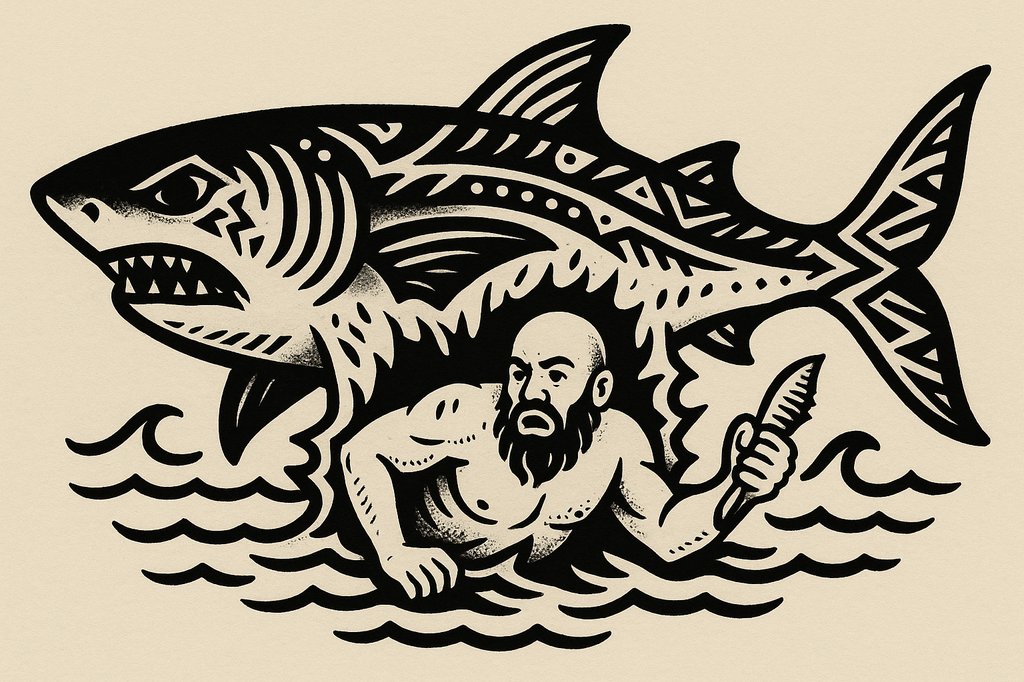


Once upon a time a Badu man named Mutuk was fishing in the sea off a rock, when his line fouled and he dived into the water to free it ; a passing shark swallowed him ("swilled him down") without hurting him.
The shark swam on northwards, and on passing over the reef of Mangrove I. Mutuk felt warm, and said to himself, " Now we are in shallow water." When the shark plunged into deeper water Mutuk felt cold and knew they had descended again ; later on the shark swam to Boigu and was left stranded on the reef by the receding tide. Mutuk felt the heat of the sun beating upon the body of the fish and knew that he was high and dry, so taking a sharp shell {id or ido) which he carried behind his ear, he hacked away at the belly of the shark until he had sufficiently ripped it open ; on emerging from his strange prison he found all his hair had fallen off.
Mutuk found his way to a water-hole on the island and climbed a tree which overhung it. By-and-bye a woman came to draw water, and it happened that she was no other than Mutuk's sister, Metalap, who had married Piti, the chief of Boigu. Looking into the well whilst getting water, she saw in it the reflection of two faces; one was her own face, but whose was the other ? She pondered, she moved her head, and the reflection of it simultaneously shifted also, but the other one did not move, so she proved it was not hers ; then she looked up and saw her brother in the tree. She asked if it was really he, and assuring her of his identity, he explained how he got there, and implored her to persuade her husband to take him back to Badu, as his wife and piccaninny were crying because they thought he was dead, and the people would perform funeral ceremonies for him (" make him devil"). She told him to wait where he was till the evening and she would then take him to her house ; she went home and brought him good dugong meat and yams and a bamboo knife, upi^ to cut the meat with. At night time Metalap brought Mutuk into her house, and sent a boy to her husband, who was away, to tell him to come home ; he sent back word that he would not come unless told for what he was wanted ; she replied through the boy that he must come, and then he returned.
On hearing the whole matter Piti decided that Mutuk could not be sent home then, but must wait a month ; to enliven his term of exile three wives were given him, and his hair began to grow again.
At the expiration of the month the chief took Mutuk in a canoe full of Boigu men back to Badu. When the canoe was sighted by the Badu men they said, "It is a Badu canoe — no, it is from Mabuiag — no, it is from Badu." On the canoe nearing shore they recognised Mutuk standing up, and were much astonished, as they thought him dead ; at first they could scarcely believe it was he, but, when sure of his identity, they felt much chagrined at having held the funeral ceremony for a live man. They prepared to receive their guests by taking all the bows and arrows out of a house and by hiding a stone club under a mat near at hand, some one sitting upon it. The Boigu chief said that he and Mutuk would go to the village, but that all the rest of the men were to stay in the canoe. When these two were seated Mutuk's wife identified her husband, and then both he and Piti were killed with the stone club, and the men in the canoe murdered.
All the dead men were then immediately transformed into flying foxes (Pteropus), who wheeled round and round and flew away to the north.
As they passed over the island of Murtai a twig of a piner tree tumbled off" one of the flying foxes, and subsequently took root and grew into a tree which is there now, for the Boigu men had previously ornamented themselves with bunches of leaves and small twigs of the piner (coral tree, Erythrind) and of the uhu tree .
As they flew over the island of Widul another piner twig fell down and took root ; on the point of Auboit on Mabuiag an ubu twig fell, and a piner branch was dropped at Dabungai, in the same island, as witness the trees now growing. Once more the flying foxes sped northwards and wheeled above their native island of Boigu ; the women, looking up, recognised them and wept, for they then knew their husbands had been murdered at Badu.
The flying foxes passed on to Daudai and came to a hollow zunga tree ; all entered it except Mutuk and the chief, who sat on the top of the tree.
Shortly afterwards a man named Budzi, who possessed a large family of daughters, came along with a basket looking for crabs (gittla) and " iguana" ; as he was stooping to pick up a crab the flying foxes in the hollow tree looked out and laughed. In great surprise, he looked up, saying, " Who laughs ?" and proceeded to catch another crab ; again the flying foxes laughed, and Budzi once more looked up and said, " Who laughs ?" This time he saw the flying foxes in the hole, and jumped up and caught all of them and put them in his basket. Then he sat down at the end of a log, and taking the flying foxes out of the basket, he bit off the head of Mutuk and threw the body on one side. Mutuk immediately resumed his proper form and, unknown to Budzi, sat down on the log beside him ; all the rest were served in the same way until only two flying foxes remained. Budzi, thinking to himself, " I've got plenty kaiki now," turned to look at his heap of headless flying foxes, and to his great surprise saw, instead of them, a row of men sitting on his log. He then bit off the heads of the two remaining flying foxes and saw them transformed into men. Budzi said to the men, " You are my men now— I've got a lot of daughters at home, you shall have them and stay along with me" ; so they all went off to Budzi's house, which lay to windward {i.e., to the east or south-east). Budzi gave his eldest daughters to Mutuk and the chief, and the rest fell to the lot of the other men. That night, as soon as Budzi was asleep, Mutuk said to his wife, " You come along — we no stop here," and all the men departed with their wives and went a long way in the darkness.
In the morning, when Budzi woke, he found his hut empty ; he rubbed his eyes and looked again, but saw no traces of his daughters or their husbands ; outside he easily found their tracks, and immediately followed them. On coming up with the fugitives he asked why they had deserted him ; they replied that there were too many mosquitoes at his place. " There are no mosquitoes here," said Budzi ; " we will stop here." That night, as soon as the father slept, his family again decamped ;*when Budzi discovered their second flight he saw it was useless to attempt to retain his daughters, so refrained from following the party.
Budzi, thinking to himself that it was no good one man living in a house by himself, went into the bush to find a madtib bushman who would share his house. He called out, and a man replied. Budzi asked his name; it was Madub. "Well," said Budzi, "you come along and live with me, your name is no longer Madub, it is Budzi — same name as my name — what is your name ?" The bushman made no reply, so Budzi caught hold of him and pulled him, and his arms and legs came off. A second time Budzi went into the bush, and the whole adventure was repeated, even to the dismembering of the unfortunate bushman. A third attempt brought better results, for the bushman answered " Budzi", on being asked his new name, and then followed the original Budzi.
At sunset they came to what they took to be a large mound of the wild-fowl (Megapodius) and slept on the top of it. In the morning Budzi found a white-egglike body, and tasting it, found it sweet — it was the root of a wild yam ; his namesake also awoke and saw and tasted it ; they then discovered that the hillock was not the nest of the mound-bird, but the heap at the roots of a gigantic yam. " By God !" Budzi exclaimed, " he no gammon fine yam ! this yam belongs to me ; if any man take him may he have elephantiasis (koingnar) in his legs. They then wended their way homewards, and the two Budzi lived together.