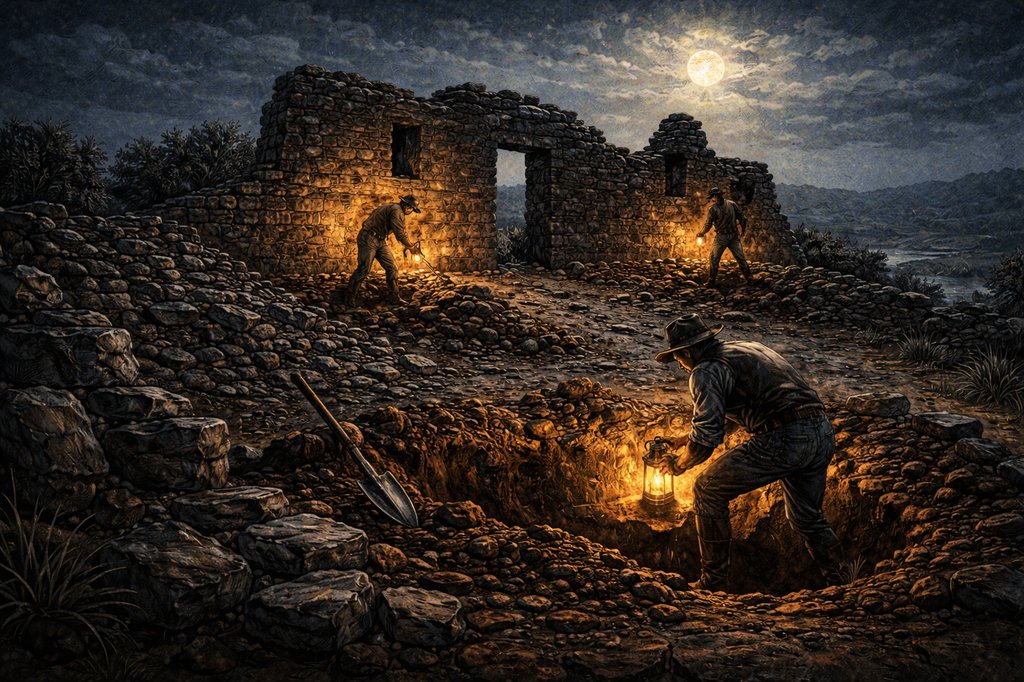


Fort Ramírez is in the southern part of Live Oak County, on my father’s ranch. When I was a boy, some of the old rock walls were still ten or twelve feet high, though already crumbling. As far back as I can remember, or have heard men tell, there were holes made by treasure seekers all along the walls, inside the room, and for hundreds of yards out from the place. When I revisited the location last summer, I found the walls all down, most of the rock lugged to one side, and indeed a large part of the foundation dug out. Some of the excavated stones weighed, I dare say, two hundred pounds. The ruins stand on the point of a hill overlooking the immense but dry bed of Ramireña Creek, which, old men say, in the days of the open range was nearly always running. A deep but short gorge called Ramirez Hollow runs up near the hill.
There are two distinct legends about the old place: in one it is a fort; in the other, an old sheep ranch. In later years, the fort idea seems to have gained ground. Mr. E. M. Dubose of Mathis says that he first got the straight of the matter from an old Mexican who was looking for the Casa Blanca site. According to this Mexican, a band of bandidos had, in the early days, captured the fort from Spanish priests who were using it as a kind of ungarrisoned mission. The bandits pillaged the place of a cross of precious metal, golden candlesticks, and other costly paraphernalia, and took up their headquarters in a secret cave a short distance east of the building. Later they were driven out of the country by the Texans, leaving in the cave all their churchly plunder, as well as much money robbed from freighters and ranchmen. The problem for treasure seekers has been to locate the cave, of which there is now no sign. [...]