

There can be no question but that historical and traditional stories are strangely woven together, and with many tangles of net-work, in the fireside narratives of our peasantry. These regarding Timogue old church, and the castle which formerly stood near it, are examples of fact and fiction, it should prove difficult at present to unravel.
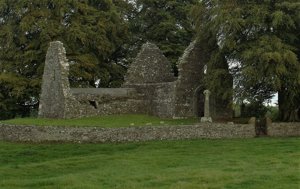
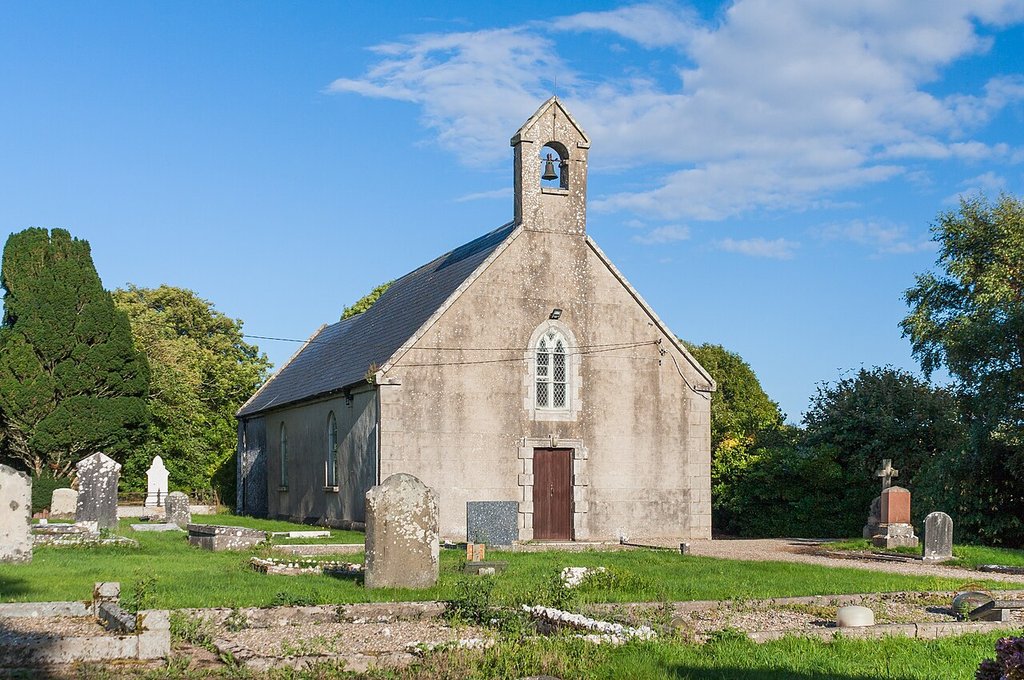
Although of comparatively modern erection, and architecturally of a debased style, the church seems to rise on the ruins of an earlier structure; for on the exterior, the grass-covered graves, and rude headstones, noteless of inscriptions, rise nearly to the sills of the windows, owing to the accumulation of mouldering human remains that have been deposited under earth, so frequently re-opened in the well-known family burial-plots, for centuries long past. Those first entombed there are unrecorded in documents, and not remembered in traditions.
All over the cemetery—a popular place for interments—flag-tombs, half hidden in the mould, or headstones sinking deeper into it each year, are interspersed with the furrows showing where the latest graves had been opened and sodded over, while crowned with a luxurious crop of grass and weeds. Solitude has settled round the site by day; and night adds to it a still deeper gloom.
At some short distance from the declivity, a bright stream, taking its course from the Luggarcurran hills, meanders over its bed, strewn with smoothed rocks, and innumerable pebbles of nearly every variety of shape and hue.
Near the high-road stood the former castle, where, it is stated, the O’Kellys, the Fitzgeralds, and the Byrnes held sway in succession. Numerous are the tales of massacre and usurpation which built up the later inheritance, and of fraud united with cruelty, that rooted out the original possessors, clansmen of the O’Moores. Reprisals were the consequence; nor are the traditions at all inconsistent with a lawless state of society which prevailed but a few centuries back, and which preserves for the present age many romantic episodes of family history.
During the reign of Queen Elizabeth, the Castle of Moret, adjoining the Great Heath of Maryborough, was sacked and burned by the Irish. It was then occupied by Gerald Fitzgerald, married to a daughter of the detested John Bowen, the Sáith a-Fiecha of Ballyadams Castle, which still remains in a good state of preservation. His life, and probably that of his wife, was forfeited on this occasion; however this be, the remains of both lie within a vault of the church, as a marble monument, with an inscription and armorial bearings on it, still certifies.
The children of Sir Gregory Byrne, an army contractor during the reign of King Charles II., and a person of much celebrity at that time, formed family alliances with the Fitzgeralds of Timogue. The inscriptions on their flagstone tombs within the church, and yet legible, indicate their respective names and relationship.
However, no trace of their castle now exists; the proprietorship of their lands has passed to other occupants; the old flour-mill, a later erection, is in ruins on the river bank beside that bridge over which the road leads, and under the arches of which the stream gurgles.
But weird stories were told of goblins that haunted that neighbourhood, and especially of melancholy groans that were heard from the churchyard during the still hours of night!
Late in the last century, the trade in wool was very considerable in the midland counties of Ireland, and a revival of home manufactures caused a brisk demand for fleeces, which were brought in packs by the shepherd farmers to certain established fairs for sale.
On one of those occasions, a wool-comber and his driver of the cart, on which the well-stuffed wool-packs had been placed, were returning from the fair of Ballynakill; and rather belated, they were approaching the old graveyard of Timogue, which was observed on their right, with the high wall surrounding it on the roadside.
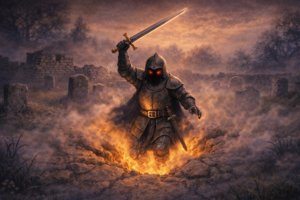
The night was dark and stormy; the witching hour for goblins stalking abroad had come; nor was it pleasant to trudge the miry way; when suddenly, a blaze of fire shot up from the graveyard within the wall, in which a breach seemed to yawn wider each moment, until at length it opened for several yards.
Then followed a loud rumbling noise, while a black coach, with a coachman and four headless horses, was observed rolling out towards the road, to the horror of the unprotected travellers.
Nevertheless, as the urgency of fear was uppermost, and as flight towards the bridge and their homeward-bound course was instinctive, the driver and his master jumped on the cart, the former raised his whip, and the horse, in like manner seized with terror, bounded forward.
Nearer and nearer the unearthly equipage seemed to gain upon them; louder and louder arose the rearward clattering of hoofs and the rolling of wheels. Petrified with fright, the fugitives ventured to look behind, and they beheld one of the most diabolical countenances it could be possible to imagine looking out of the coach, and with a mouth grinning from ear to ear, as if gloating over the idea of seizing the fugitives.
Agonized beyond endurance at this awful spectacle, the driver and his companion screamed out with all their might; but they had already reached the crowning arch of the bridge, where the water beneath proved to be their safeguard, and a barrier over which the demon coach could not pass.
Suddenly it stopped short; then turned back; by degrees, the sounds of horses’ feet and rolling wheels grew fainter, as that apparition vanished in the distance.
Such was the story as narrated to the writer, now many long years ago.