

In the seventh century a little lad kept watch over the sheep in the valley of Lauderdale. This valley, which is in the country we now call Scotland, was in those days part of the kingdom of Northumbria.
Now, the shepherd boy was called Cuthbert. He was left an orphan when but a tiny babe, and a good woman watched over his childhood.
He was a strong child, and tales are told of him how he delighted to walk on his hands and turn somersaults, as boys will. As he grew older he was chief among the lads of his own age in running, jumping, and wrestling; he practised these arts meaning to be a fighting man, which of a surety he was, yet not in the way he dreamed when wrestling with the other lads in Lauderdale.
For one night, as he watched among his sheep, he knelt to pray. The night was dark and overcast, no light from moon or stars; but suddenly Cuthbert perceived a ray of light which grew brighter and brighter, while upon this ray angels descended. The boy gazed, scarce believing his own eyesight the while the light continued. Then he saw these angels ascending, bearing with them one whom seemingly they had come to meet; and from the one who was with them also issued a heavenly light. Then Cuthbert wondered what this vision might portend.
In the morning he was told how the holy Aidan of Lindisfarne had died during the night, so he judged he had seen the Bishop's soul with the angels. Henceforth he was filled with a desire to become like unto him; so he went to Melrose, where novices were taught. Here he became the beloved pupil of the Abbot Eata.
Nor is that wonderful, for Cuthbert, in his vigorous body, had a strong mind and a great desire to serve his Lord faithfully. He would walk to and fro among the people, seeking to win the heathen to Christ, preaching to and confessing those who were in the faith. No storm daunted him. In the wild, rough days of the drear November or through the deep snows of winter he would cross the moors alone to the distant glens and valleys where he might win even one soul to Christ. Often hungry, often thirsty, sometimes so weary that scarce could he struggle on, yet he never turned back. Among those outlying hills and dales were those who, professing Christ in name, were apt to fall again into idolatrous ways, and to them Cuthbert went forth.
He, too, like Servan of Culross and many another saintly man, loved animals and birds. It is told of him how one night he went out to pray, as was his wont oftentimes, and another monk followed him to see the reason thereof.
He found Cuthbert kneeling nigh unto a stream praying; and because the night was bitter and he had come through the wet grass, Cuthbert's feet were numbed and frozen by the cold. But presently two otters came from the water and licked Cuthbert's cold feet the while he prayed. They licked them until they were warm and dry, wiping them with their hair. Then that monk stole away, marvelling that Cuthbert liked to pray in the cold air instead of in his warm cell, marvelling also at the otters' kindness.
Now, when Cuthbert was not yet thirty, Eata became Abbot of Lindisfarne, taking Cuthbert with him as Prior. At Lindisfarne, as at Melrose, Cuthbert laboured with the same zeal for the souls of his fellow-men.
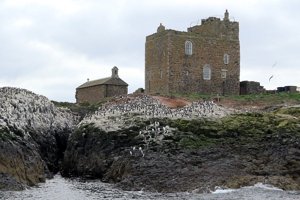
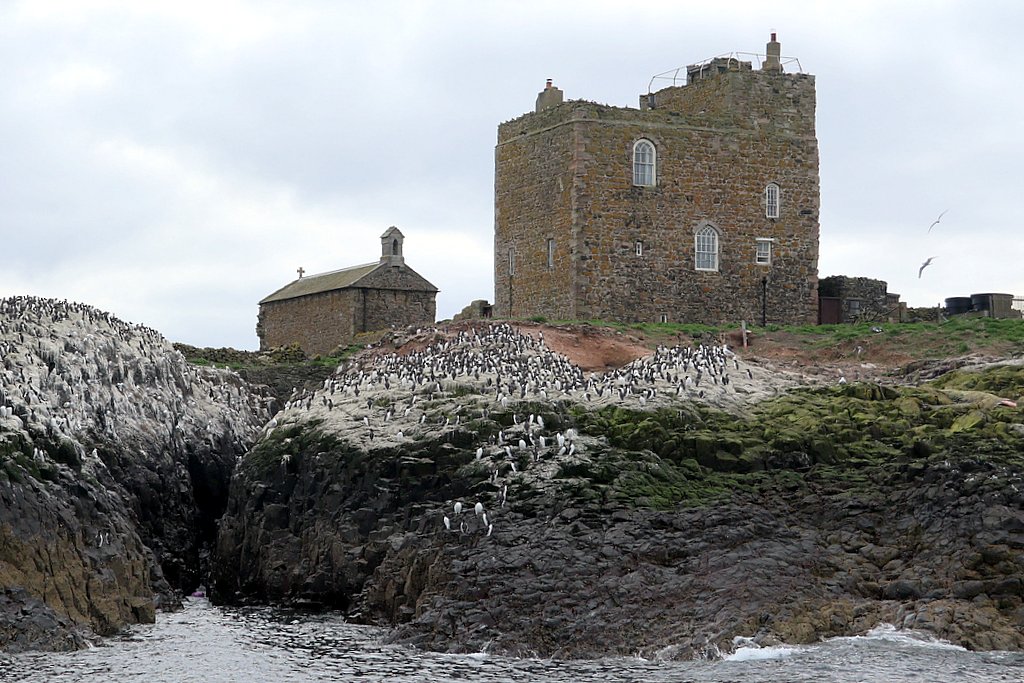
For twelve years he was Prior at Lindisfarne; then he betook himself to a small island seen from Lindisfarne, and called Fame. None dwelt thereon, for it was said to be the haunt of evil spirits. But nought evil disturbed Cuthbert during his sojourn there; instead, the wild birds dwelt with him, becoming gentle and familiar with the saint. To his influence folk attribute the tame ways of these sea-birds, for generations of them have shown friendliness to man since S. Cuthbert dwelt among them.
But now folk seek to steal the nests and shoot the birds, forgetting the saint's love for them, forgetting also the promise that he made to them that men should not destroy their homes. “S. Cuthbert's Birds” they are called, and are not to be found in any other place in the British Isles. On the same island, too, are certain small shells which folk call “S. Cuthbert's Beads.”
Now, Cuthbert did not withdraw to Fame to be away from mankind; he used to receive people there, building a place where boats might anchor, and a refectory and guest-chamber for the pilgrims who came there to seek his aid.
Here many a sin and sorrow laden heart found comfort, going away cheered by the love and wisdom of the saint. Here also came Herbert, who was of all Cuthbert's friends the best beloved. Each year the priest Herbert left his island in the peaceful Lake Derwentwater to go to that other isle in the Northern Sea. Then would the friends join together in peaceful and loving converse, speaking of the joys of the life to come, while the great waves beat against the lonely rock.
Thus eight years were passed, until came the day when the King of the Northumbrians, with his nobles and almost all the community of Lindisfarne, came to Cuthbert, beseeching him to accept Episcopal dignity. He had no wish to leave his dear island, but at last he was persuaded to become Bishop, although it was to Lindisfarne where he had lived as Prior that he now went as Abbot and Bishop, and not to Hexham, which had been first offered to him.
Here, as Bishop, he worked as he had done when he was a monk, Prior, and hermit. As of old, he wandered over hill and dale, sleeping under the boughs of the trees; for food, content with a crust of bread or the herbs of the fields; for drink, the pure water of the streams. His friendships continued: those he had loved when a little shepherd boy he loved still, now he was raised to the dignity of Bishop. As in his childhood he had faithfully watched over his earthly master's sheep, so in the prime of his age he was a loving shepherd to the sheep of his heavenly Master.
After celebrating the Feast of the Nativity in A.D. 686, he felt that the end was coming; not for long would he be spared to labour in this world. He again withdrew to the quietude of Fame; here he would breathe his last. The monks from the Abbey came often to see him during this long, painful illness, and Cuthbert himself gave them instructions for his burial. He told them to place his body in a linen cloth, which, he said, “I was unwilling to wear in my lifetime; but out of affection to its donor, Verca the Abbess, favoured of God, I have kept it for my winding-sheet.”
So he was laid to rest wrapped in the linen shroud given to him by his friend Verca. And on the same day and at the same hour that Cuthbert died his dear friend Herbert passed from this world.
Some time before Herbert had asked Cuthbert to pray to God to grant him the desire he had to die when his friend should leave this earth. Then Cuthbert had prayed that Herbert might have his wish: and, behold! so it was, for though they never met again in this world, yet in the hour of death they were united—Cuthbert dying on that granite rock in the storm-tossed sea, Herbert closing his eyes in sleep on the peaceful isle in the quiet lake, surrounded by the wondrous beauty of the Fells.