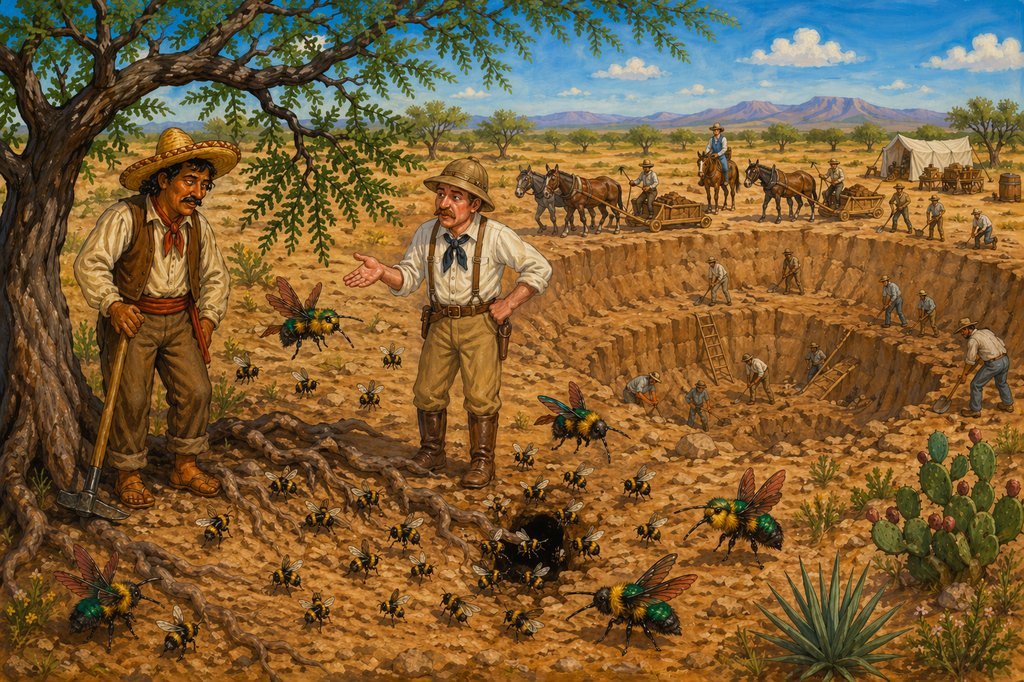


“One time there was a white man who had got wind of a lot of Mexican dollars buried down below Roma. He had the place all located, and was so sure of himself that he brought in an outfit of mules and scrapers to dig away the dirt. He was making a regular tank, digging down to that money, when a Mexican living down there, whom I’ve known all my life, came along.
“This Mexican, when he came close to the tank the white man was digging, stopped a minute under a mesquite tree to cool off, and when he did he saw a hoe lying on the ground, half covered in the dirt. He reached down to pick it up, and then he saw a whole maleta of coins. A maleta, you know, is a kind of bag made out of hide. This maleta was old and rotten, and when he turned it over with the hoe it broke open and the gold money just rolled out in the dirt.
“Directly, the Mexican went over to where the white man was bossing the teams, and he asked him what he was doing. The white man told him that he was digging up some buried money.
“‘Well, you’re digging where it isn’t any use to dig,’ said the Mexican. ‘The money isn’t there; it’s over here. If you want to see it, come along and I’ll show it to you.’
“The white man laughed as though he did not believe what the Mexican was telling him, but he came along. When they got to the mesquite, there wasn’t any money in sight, but there was a hole down at the root of the tree, rather like a badger hole, and bumblebees were going in and out, making a roaring sound, and the dirt was alive with great big bugs—maybe tumblebugs—only they were humming and making a sizzling noise and working around in a fearful way.
“‘Huh, is this what you call money?’ said the white man, stamping down on the tumblebugs. ‘They’ll eat up all the gold if they roll it away.’
“‘That’s all right,’ said the Mexican. ‘There were dollars of gold, and silver too, here. But there aren’t now, I admit, because those dollars evidently weren’t intended for you. White men didn’t hide that money, and it isn’t meant for white men to find it. No matter how much you dig, or where, now, you won’t find anything.’
“Sure enough, the man kept on digging, and he got nothing. One time I asked the Mexican why he didn’t go back and take out the money.
“‘I didn’t want any of it,’ he said. ‘I never put it in the ground. It wasn’t mine any more than it was that white man’s.’
“A few days after he saw the money, though, he went back and scratched around in the dirt a little and picked up an old square Mexican dollar. He brought it to Roma and bought some flour and some coffee and some candy, and gave some of the candy to my wife. She was living down there and knew the man well, and she told me many a time how she ate some of the candy that the Mexican bought with that old square Mexican dollar. I always have thought that that money was intended for him, but you know how some people are, and I can’t say as I blame him for not touching what he had no right to. If buried money like that is intended for a human being, he’ll come by it just easy and natural. If it’s not, he won’t come by it, no matter how much he hunts. Even if he did find it, and it wasn’t intended for him, it would prove a curse. I’d be afraid of it myself.”