

The opening between Aranmore and Inishmaan, or the Middle Island, is called Gregory’s Sound. According to the islanders of Aran, its name was derived from a certain venerable man named Naomh Greoihir, or St. Gregory.
This holy penitent came originally from the mainland, lying in a south-eastern direction. There he had been guilty of committing some very grievous sin, and he almost despaired of forgiveness. In his anguish of mind, Gregory gnashed his teeth together, and in doing so happened to bite off his under lip, which gave him a frightful appearance.
At this time, the holy abbot Enda lived on the Islands of Aran. Gregory took boat, and sailed over to Inishmaan, hoping to receive religious consolation, and to appease his remorse of conscience. He wished to become one of St. Enda’s monks, and to spend the remainder of his days in exercises of the most rigorous penance.
Yet, on revealing to St. Enda the heinousness of his crime, the great abbot refused to admit him as a member of his religious community, lest it might prove a cause of scandal to his brethren. However, the superior promised to give him spiritual consolation and advice, if he lived in a retired place, on the north shore of Inishmaan.
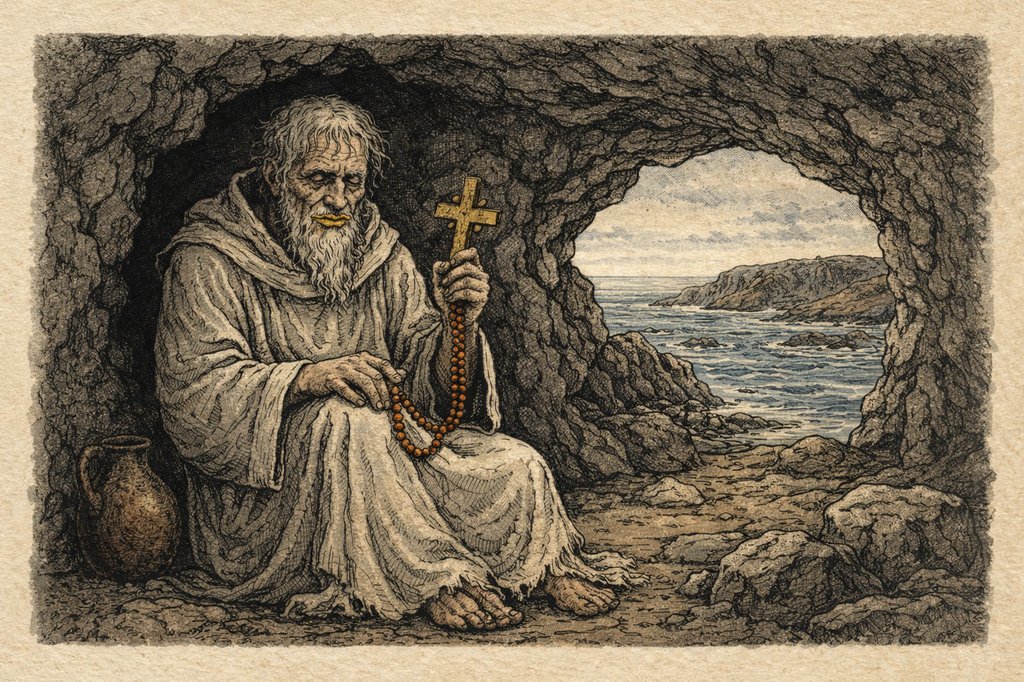
There was to be found a cave, in which Gregory took up his abode, and underwent a severe course of penance. To make amends for the disfigurement caused by the loss of his lip, St. Enda caused one of gold to appear in its stead. Hence, in after time, the pious anchoret was denominated “Gregory of the Golden Mouth.”
A rock and a little cove near his hermitage were called Portaich; and in after time, the place of his habitation was known as Gregory’s Cave. Here the fervent penitent spent the remainder of his life in solitude and prayer.
During the time of his sojourn, St. Enda and his monks often passed over from Aranmore to visit him, and to solace the hours of his voluntarily-imposed exile. Gregory lived for a long time there, and when old age came on, his declining health warned him that death was near.
He sent for the monks of St. Enda, to prepare him for a final departure, and he received at their hands the last rites of the Church. But such was his great humility, that he considered it should be a sort of profanation to have his remains interred among the saints of Aran; and he therefore asked, as a dying favour, that they should be towed out, in a sort of coffin or tub, into the middle of the sound, and there consigned to the deep.
In compliance with this request, when his breath departed, and the body was without life, his relics were taken and placed in the tub, while stones were also added to increase the weight, so as to cause them to sink in the depths of the sound.
The monks rowed over towards Killeany, after their work had, as they thought, been consummated. Yet what must have been their surprise on landing, to find the tub—supposed to have been at the bottom of the ocean—high and dry on the beach, at a place now called Port.
Again, they took back the tub or coffin containing Gregory’s relics, and sunk it once more in the middle of the sound. On landing, they found a repetition of what had previously occurred.
Taking back the remains a third time, these were again sunk in the sound. Yet, on landing that third time, the coffin lay before them on a bank of sand.
Astonished at this spectacle, and moved, as it were, by a sudden inspiration, they cried out:
“Iongnadh, iongnadh, adlaicmaois ameasg na naomh.” “A miracle, a miracle, let us bury Gregory among the saints!”
The place where his remains lay was not far from the burial ground and church of Killeany, where, even then, numbers of holy monks had been interred. A grave was there opened, and in it the body of Gregory, the Recluse, was deposited.
A green mound, rising amid the drifting white sands that are often swept by the eastern or southern winds over the burial ground, is yet shown. No family on Aranmore would encroach on this sacred site, while interments are being made among the saints reposing at Killeany, without note or distinction.
Solitarily as he had lived, the bones of the penitent Gregory are isolated, on the verge of the burial ground, and his grave has no monument. Yet still the Aran guide, Derane, and the islanders, point it out to visitors, and tell the romantic story of its occupant.
It is somewhat apart from the interesting ruins of old Killeany, which, according to tradition, is the mortuary church of St. Endeus.