

“Men called him Cobban Saer, and many a tale
Yet lingers in the bye-ways of the land,
Of how he cleft the rock, and down the vale
Led the bright river, child-like, in his hand:
Or how on giant ships he spread great sail,
And many marvels else by him first plann’d.”
— Thomas Darcy McGee’s The Gobban Saer.
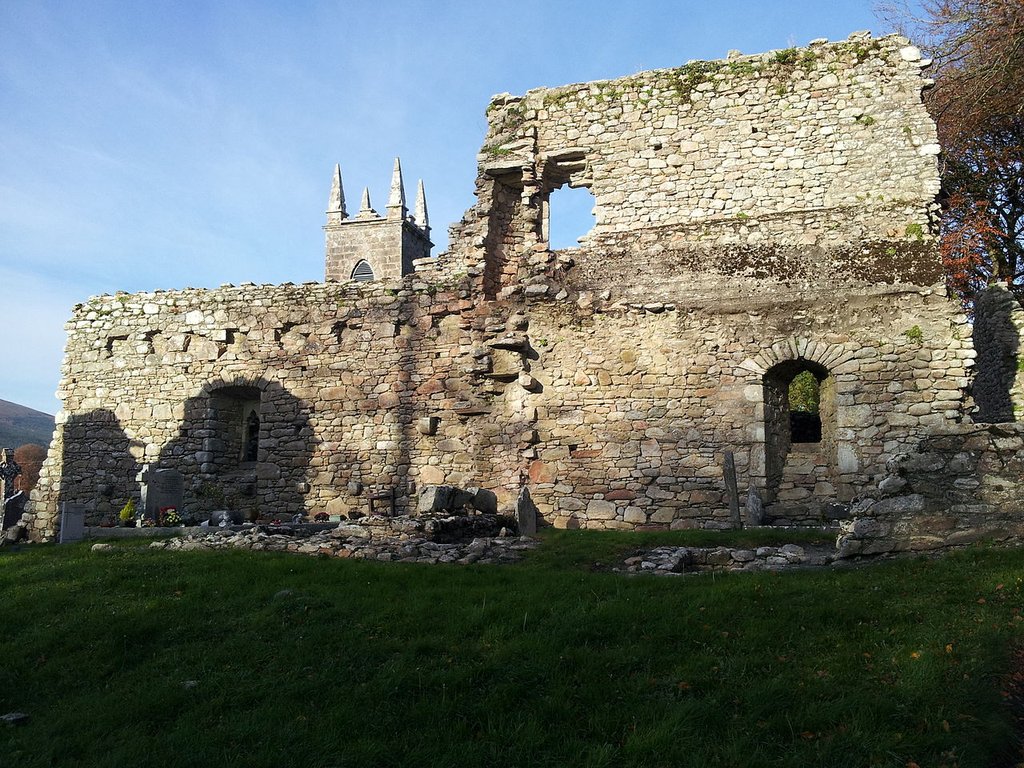
Many traditions of the Gobban Saer are still told in the locality of St. Mullins; one of these relates how, being the cleverest builder in Ireland, he arrived once footsore and weary at the Church of St. Mullins, which was then building.
He always took a great interest in the erection of churches; and when not engaged as the architect himself, the Gobban had a turn for visiting places where he knew work of the kind to be progressing, so that he might aid or give useful hints to the builders. He usually travelled in his working dress, which was ragged and torn, so that from his outward appearance no one could suspect he was an architect of the greatest genius.
When he reached St. Mullins, a number of mechanics and labourers were busy under a foreman’s direction, and they were then engaged in putting on the church-roof. He sat down on a stone that was near, and gazed intently on their labours.
The workmen who were engaged there noticed the stranger, and scoffed at his poor appearance, as he was looking at their work. At last, they gave vent to rather uncomplimentary observations, and the accomplished Gobban had to bear patiently such remarks as these, although he began with the common salutation of:
“God bless the work, boys!”
“Musha, where did you stroll from to-day, for an idle tramp?” cried out a man that was on the roof.
“That’s none of your business to know,” returned the Gobban Saer.
“Do you want a job, my good fellow, or can you do a bound’s turn at all?” inquired another labourer.
“That you’ll find out in good time,” replied the Gobban to his impertinent questioner.
“Did you ever learn any trade?” asked the foreman.
“Maybe I did, and maybe I didn’t,” said the Gobban, “and you may want my help before long.”
“And what trade were you brought up to, my good man?” inquired the foreman.
“I know a great many,” returned the Gobban.
“Then I suppose you are a Jack-of-all-trades, and good at none,” said the foreman.
“Are ye a mason?” cried one of the craft, who was engaged dressing a quoin-stone for building the vestry.
“I am, and a master-mason at that,” replied the Gobban.
“And maybe ye are a carpenter too,” cried another, who was sawing planks for the construction of the church doors.
“Yes, and a first-class one,” answered the Gobban.
“I suppose you can do smith-work also,” cried out a man that was working at the anvil to forge iron bolts for the doors.
“I am, and a lock-smith, and a gold-smith, moreover,” returned the Gobban to the last questioner.
“Do you belong to any regular Trade Society at all,” inquired the foreman, “or can you show your card of membership?”
“That I do not, and cannot,” said the Gobban; “but while I am eating a bit of oaten cake, and resting myself here, I’ll just be at hand to let you know what I can do.”
At that moment, the man on the unfinished roof was laying the rafters, and he desired to shape a plug or wedge to secure one of these to a beam; but after repeated efforts with an adze, he found it would not fit the hole for which it had been intended, and at last, he told the foreman of his failure.
As being such a very clever fellow, the foreman then asked Gobban was he able to chop it out in a shape to fill the space. Asking to see what place the plug was required for, Gobban was pointed out a hole high up in one of the timbers of the roof.
“Give me a hatchet,” said he, “and I’ll fashion the plug here, in less than a jiffy.”
The foreman then reached an axe to the Gobban Saer. Spreading his handkerchief on a stone at hand, “to save the edge of the hatchet,” he soon chopped out the plug. Then tossing it up into the hole, he secured it there, by throwing up the hatchet after it; and the instrument fell on the plug, which entered the right spot, where it fitted exactly the opening.
“Can any of yees do the like of that?” cried the stranger, as he gazed in triumph around the circle of workmen present.
“Begorra,” shouted all, “that bangs Banagher, and you’re a regular genius!”
“Didn’t I tell yees,” says he, “that yees ’ud want my help, and I don’t think yees ’ill sneer at me any longer.”
He had then rested sufficiently, and having finished the last morsel of his oaten cake, he put on his hat, took his blackthorn stick in his hand, and proceeded on his journey.
He had not told them his name, nor was it necessary; for the workmen all knew, that no man in Ireland could attempt the feat he accomplished other than the Gobban Saer.