
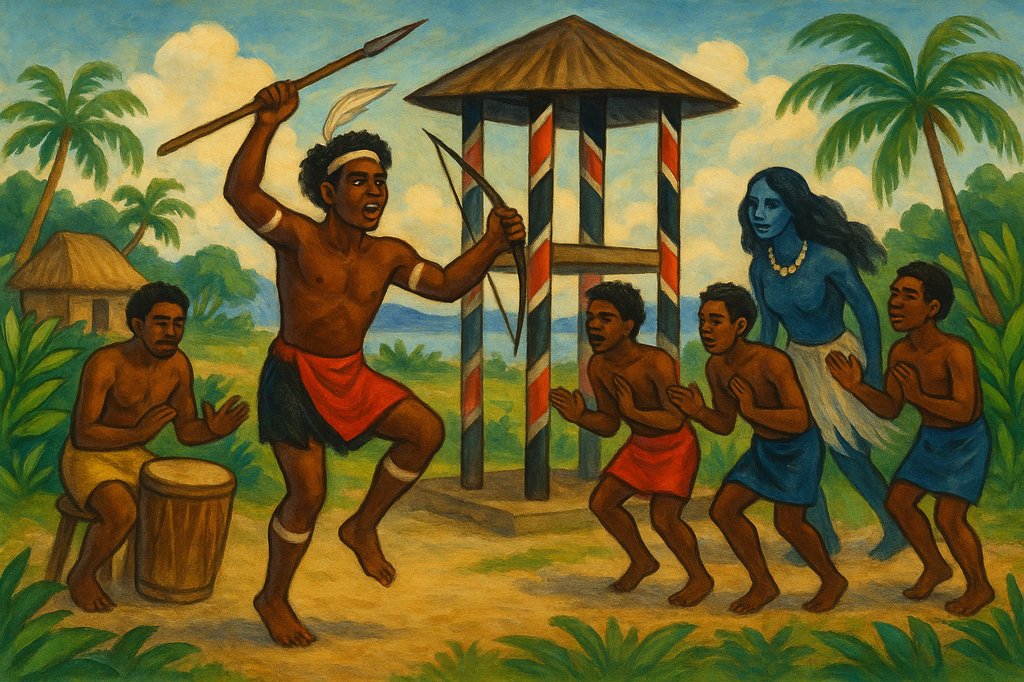


On a small sand-beach named Boigu, amongst the mangrove swamps on the western side of Moa, lived a married woman named Aukwiim, and Wauwa, her unmarried sister.
One day Aukwiim put her baby boy, Tiai, into a basket and hung him up on a tree outside her house whilst she went to spear fish, it then being low tide. She found a pool on the reef full of big fish, so she soon filled up her basket and returned home. After cooking and eating some fish she erected a light framework (noi) over the fire on which to dry and smoke the remainder. This done, she slept.
During the night "Wauwa's inside tell herself, 'Why she no give me fish—I sister?'"
At daybreak, after Tiai was suspended from the tree, Aukwiim again went on the reef, and speared plenty of fish, and brought them home in a basket. On her return she cleaned the fish, and put most of them on the noi to dry; the remainder she boiled in the shell she used as a saucepan, and ate them; but did not give any to Wauwa.
Next day Aukwiim once more started for the reef, and Wauwa, being "wild inside", took an arrow, and, thrusting it through one of the eyes of Tiai, killed him. Meanwhile Aukwiim was vainly looking for fish. At last she said, "It's a bad day for me, there's something wrong somewhere." When the tide turned she ran home, anxious to get back to Tiai, as she had left him for so long. "Ulloa," she exclaimed, on reaching home, "my boy is dead; I think Wauwa has killed him."
The mari, or spirit, of Tiai went to the island of Boigu, and having the appearance of a man, he stopped along with the grown-up men. When Tiai mari arrived, the Boigu men were playing with small spears, which they heaved with both hands, and they received him kindly.
Aukwiim, having prepared the bones of Tiai, hung them in front and behind her, and rubbed her body all over with mud. Leaving Boigu, she went to Dabu, a place where the channel between the islands of Moa and Badu was at its narrowest. On the opposite shore of Badu resided a man named Baigoa, who was possessed of more than human powers. Aukwiim called out to him to ask him to help her to cross the strait between the two islands. At this spot it is a little over a mile wide, and she had no canoe. By his assistance she crossed the channel. Baigoa is still to be seen on the shore of Badu, but now he appears as a long rock close to deep water.
In reply to Aukwiim's inquiries, Baigoa said Tiai was not there, but had probably stopped at Kulkwoi. Aukwiim at once proceeded to Kulkwoi, and found the men playing at throwing the spear. On seeing Aukwiim they were much alarmed, thinking she was a dorgai; she assured them as to her identity, and showed them Tiai's bones. They informed her that Tiai was not there, but they thought he might be at Zauma. She travelled northward to Zauma, where the men were also practising spear-throwing, but with the same result as before. Following her directions, she went on to Bokún, and thence to Tulo, the most northerly point of Badu. In both places the spear-throwers could give her no information.
From Tulo Aukwiim walked over the sea to Sipunga on Mabuiag, thence she walked along the beach to Bau (the present village), and lastly went to Dabonai, where the water-hole is on the northern side of the island. Her search was as bootless in Mabuiag as in Badu. She then walked across the sea to Dauan, but with no result; finally she arrived at Boigu.
The men at Boigu were playing at spear-throwing, and Aukwiim stood watching them. When the old men looked round and saw her they called out and said she was a dorgai, but Aukwiim maintained her humanity and made her usual inquiry. It so happened that Tiai was standing close by, and he looked at the bones slung round his mother's neck, and spoke to himself, "I think I am a spirit, and not a man, though I took myself to be one," but he said nothing, and kept on thinking. When all the men had retired to the men's quarters (kwod), Tiai, having fully considered the problem, said to them, "Well, old men, you must cut four wooden posts for a sara and carry them to a clear space, and not one of you must speak. When the wood is ready you must dig four holes and raise all four posts into them at the same time, then put sand round the base of the posts, and press in tightly, and mind all four are done at the same time. The sara posts are to be painted red round the middle and black above and below; a roof is to be built over the platform which is to be erected on the four posts."
When all this was done Tiai placed a dugong harpoon on the top and crept inside the erection, he being watched by a crowd of men. Some of the men then softly beat their drums and Tiai made the sara shake. When he stopped, the men beat their drums more loudly, and Tiai stood up on the roof, having a dugong harpoon on one side of him and a bow on the other. As the drums were again beaten Tiai seized hold of the dugong harpoon and bow. Once more the drums were beaten and Tiai leaped on to the ground. More loudly still sounded the drums, and Tiai danced his own funeral dance. As Tiai advanced Aukwiim followed; soon Tiai reached a hole in the ground made by some sorcery-men (maidu-laig), which he entered. Aukwiim said, "Well, Tiai, do you leave me now?" Tiai replied, "You come too"; and his mother followed Tiai into the bowels of the earth.