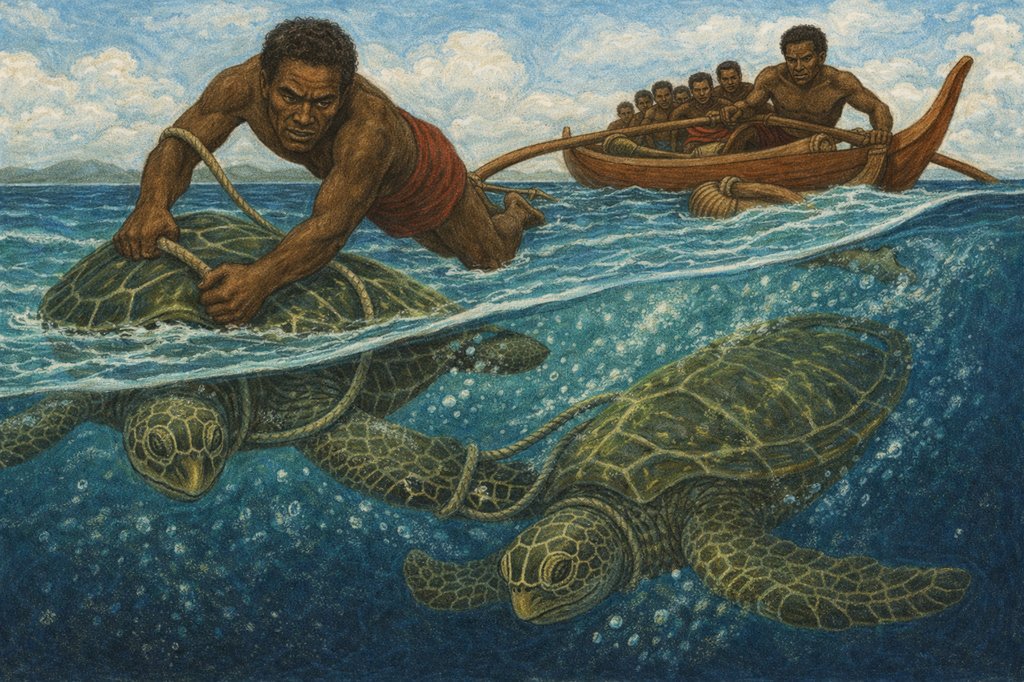


Once upon a time, a number of Murray Islanders, belonging to the clans known as Meurum-le and Komet-le, went in several canoes to the sandbank known as Kerget, to get shell-turtle and wauri. Though they stayed several days, no turtle were obtained. One man, "Mairuer", said to the coral zogo (spirit) on the sandbank, "What, you zogo, you! You no help me get turtle". The spirit was "wild", and numerous spirits of the place combined together and sent a pair of turtle in deep water. A canoe went to catch the turtle. Two men tied some rope on their arm and went to the bow, Mairuer steering. The turtle looked up, and, seeing that Mairuer was not prepared to swim, they dived down. Two other men came forward, with the same result, until Mairuer was alone left. The men said to him, "Mairuer, you only are left. We all try; we think turtle no want us to catch them. Good thing you try; we all got bad luck." So Mairuer tied the rope on his arm, and went into the boat, and the other men pulled. The turtle saw that Mairuer was ready, and they did not move, but hung down their heads as if they were dead. Mairuer dived into the water and swam to the turtle, and jumped on to the back of the male turtle and caught him. The turtle, however, dived to the bottom, and the other turtle went on the top of Mairuer and took the rope off his arm. The men, to their surprise, hauled up a burdenless rope.
The two turtles, with Mairuer between them, came up near the bow of the canoe, and Mairuer called out, "You help me!" They sank, but soon came up again, Mairuer being in the state of "no skin, all meat". Two more turtle took him and dived deep. When Mairuer re-emerged he could just move his arms, being nearly dead. Plenty turtle came up again and exhibited Mairuer dead and red all over; then they carried him to another sandbank, "Garboi." The turtle buried him in the middle of the sandbank.
The men returned to Kerget sandbank and cried. Then they went home to make a funeral feast. That night they all anchored on a reef. The west wind, Giai, came; "it meet all canoe on reef". There were two brothers, each the headman of a canoe; "the rope of them two fellows strong." Some canoes broke their rope, and the brothers sang out, "You make fast to stern of our canoes." They all did it. The names of the two brothers were Wakai and Kuskus. The men "no sleep too much" on account of the wind and rain. They kept watch. At length the rope of Wakai's canoe broke, and Wakai sang out, "Brother, my rope broke; better we go back to the sandbank." This they attempted to do, but, owing to the bad weather, they lost Kerget and made Garboi.
At daylight they went ashore and hauled their canoes on to the beach, only to find there was "no food, no water, no nothing"; and, though they had sufficient turtle, they were hard up for water. That day there was a dead calm, and the sun shone with a fierce heat. All the men put their mats over the canoes to serve as screens, and they had only salt-water to drink.
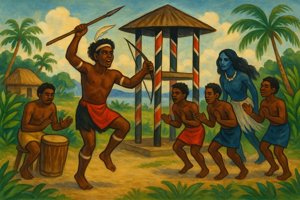
It so happened that Mairuer's friend had unwittingly discovered the ill-fated man's bones and put them together, and, without knowing whose bones they were, spoke to them, and asked them to show him some water. He then went into the canoe again and slept. In his sleep he dreamt Mairuer came to him in the likeness of a small paraquet-like bird, "the kris kris" who perched on the top of the canoe and made a chattering noise, like the knocking of the teeth together. Mairuer then no longer appeared as a bird, but as a man, and said to his friend, "You no find water! He close to small stone, dry bushes on top. You no drink at high tide; two thing come. Only drink at low water. No drink all day, or harm come to you." The man awoke, got up, and looked out; but Mairuer was no longer a man, but a bird. The kris kris said, "You follow me; you watch me good; get up — run." The bird showed him where the water was. When he returned to his canoe he felt sorry for his comrades, who were beside themselves for want of water. ["They half-tight — hard up for water."] He got some red and black paint and ornamented himself therewith, making himself like the bird. He then took a belt out of the canoe and tied it round his waist, sticking a bunch of cassowary feathers behind; in his hands he took a small shell, and danced and jumped like a bird. Thus accoutred, he went and awakened the men, telling them to wake up and he would show them where there was water. When they had rubbed the sand off their bodies he told them to bring all their vessels for holding water — shells, bamboo-stems, or coco-nut shells — and be quick and follow him, or they would not see the water. They gladly followed him and drank the water, and he told them not to drink all day; they might drink in the morning, but not in the afternoon, and concluded by saying, "The spirit {lamar) told me about two thing, I no savvy; we watch him." The men filled all their vessels with water; all men cut wood, "cut like face," and called each after his own name, and put in canoe. In the afternoon the men said to one another, "You and me go watch." They went and waited, and heard the "two thing" go into the waterhole. Babat was their name, and they made the water red. Two of the Komet-le took a mat, caught the Babat, rolled them up, and made all secure with wooden skewers, and finally deposited them in the stern of their canoe. That night they slept where they were.
Next morning they started for Mer, and slept in the evening on the Kerget sandbank. The following morning they sailed for Mer with a fair wind.
One old woman stayed by herself at the village of Werbadu, on the west side of Mer. The other women sat on the seashore, and bewailed their men-folk, deeming them to be lost; and they cried over the things belonging to the men. The old woman went to root up the tubers of a kind of yam, known as ketai. She followed the root in the ground, but could not find the tuber. Right along the length of the island the marvellous root extended; right over the high hill of Zaumo, across to the opposite side of the island at Korkor. Being tired, she sat down under a big tree; on the beach she sat down. Then she espied the canoes, and she told the women that "Canoe come from deep water". So the women sang and went to get food and roasted yams. The first canoe landed on the sand-beach at Meuram. The men took a paddle, went to the bush by the beach, and thrust the paddle into the ground; returning to the beach, they picked up a long stone, and, taking out the paddle, put the stone in the hole and covered the stone with a mat. They waited for the next canoe, the men in which repeated the process. The crews of all the canoes did the same. The middle canoe carried the Babat, and the crew also erected a stone; finally, the friend of Mairuer hung up on to a tree the mat containing the Babat. Thenceforth the Meuram-le and Komet-le had the zogo in common.
Some Erub men were staying at Mer, and they asked that this zogo might be given to them. This was not done, but they were given instead two long coco-nuts, the "eyes" of which were painted red, to be their zogo.