

HE of whom I write was the first Christian who taught the Catholic Faith to the Pagan tribes of North Britain. On a hillside at a place called Gartan, in Erin or Ireland, he was born, in a wild district of lakes and mountains, the haunt of wolves and other wild beasts. Columba or Columcille is the name by which we know him, and as one has written of him, “Meet was it that the simple and innocent man, who by his dove-like ways made in himself a dwelling-place for the Holy Spirit, should be called by that name,” for “he was angelic of aspect, clean in speech, holy in deed, of excellent disposition, great in counsel.” This name, meaning “Dove of the Church,” was given to him when a little boy by other children because he used to come from the Church to join in their games.
“Is it from the Church that our little Colum comes to-day?” they would say; for from his childhood Columba loved God, and thus it was that this name clung to him throughout his life.
There are so many beautiful stories about this Saint, that it would take pages were I to tell you half of them.
But when he was about forty years old it chanced that Columba stayed with one Saint Finnian of Moville, who had a very precious copy of the Psalter. Columba loved books, which were rare in those days, as they all had to be written by hand; therefore he sat up at night copying Saint Finnian’s Psalter. When Finnian knew of this he was angry, and asked King Dermot to take away the copy Saint Columba had made and give it to him.
Then Saint Columba said that he had laboured for the sake of the people, for their instruction it was that he so diligently made copies of the Holy Scriptures. Nevertheless, the King would not grant the copy to Columba. “To every cow her own calf,” said he, meaning that the copy must go with Saint Finnian’s Psalter.
Then the tribe of Saint Columba—for he was of a princely house—made war against the King, and there was a great battle, wherein many were slain.
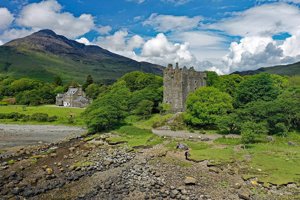
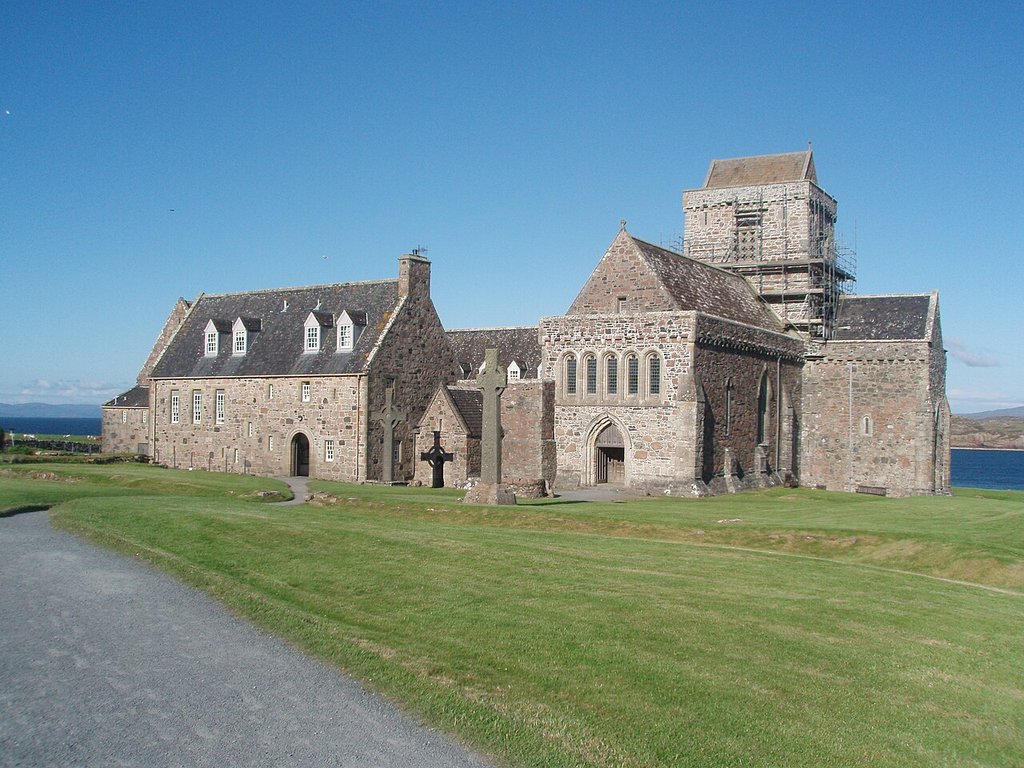
Therefore Saint Columba afterwards, being ashamed that his quarrel had caused the death of so many people, did great penance by leaving his beloved Ireland. To Alba—Scotland—he sailed, to the pagan Northmen, hoping to win as many and more souls to Christ as there had been lives lost in that battle before he would again look upon his native land. He landed at a place called Hii—which was afterwards called Hii-colum-kille, and is now Iona.
Like all good men, Columba held that to love God truly we must needs love His creatures: Columba loved all Nature—the hills, trees, lakes, beasts, and every beautiful thing God has made; and he wrote about them, for he was one of the greatest poets of those times. But perhaps he loved the birds best, for the birds had wings and could cross “the salt main on which the seagulls cry,” to the coast of Erin, to those beloved shores about which he had written as he sailed from them—
“From the plank of the oak where in sorrow I lie,
I am straining my sight through the water and wind,
And large is the tear from the soft grey eye
Looking back on the land that it leaves behind.”
It was when he was living in Iona that on a certain day he called one of the brethren of the monastery to him and said:
“On the third day from this now dawning, thou must keep a look out in the western part of this isle, sitting on the sea-shore: for from the northern region of Ireland a certain guest, a crane, driven by the wind, will arrive very weary after the ninth hour of the day. And, being exhausted, it will fall and lie before thee on the shore, and thou wilt take care to lift it up kindly and carry it to the Hospice. There thou wilt carefully harbour it and feed it for three days and three nights, when, refreshed, it will stay no longer with us, but return to the sweet country Ireland, whence it came. And I earnestly commend it to thee for that it came from the place of our own fatherland.”
The brother obeyed, and on the third day after the ninth hour he awaited the coming of the expected guest; and when it came he lifted it from where it fell and, carrying it with him, fed it in its hunger. Then Columba, knowing all things would befall as he had predicted, did not inquire of that brother about the crane, but said:
“God bless thee, my son, because thou hast well attended our guest. Nevertheless it will not tarry long in exile.”
And after three days, raising itself on high, it winged its way back to Ireland, in a straight flight upon a calm day.
Now, when Columba was an old man he knew that his departure was at hand. His exile was over; now, indeed, might his soul return to its Fatherland—not to Erin, which was but the fatherland of his body, but to that Fatherland to which Death, the messenger, summons all holy souls.
And he went one day to bless the granary, he and his servant Diormit. When he was there, he gave thanks to God that there was store of food for his monks when he should go from them. Coming from the granary, being weary, he rested upon the roadside, Diormit weeping by him, at the thought that his master was dying. While he sat there resting, the white horse which carried pails of milk from the byre to the monastery came running to the saint. And he put his head against Columba’s breast, whinnying and shedding large tears; for in some wise he knew his master would soon go from him. Diormit would have driven the horse away, but Columba forbade him, saying, “Let him alone, for he loves me. Thou, man as thou art, knew naught of my departure but what I told thee; but to this brute beast the Creator Himself has clearly in some way revealed that his master is about to go from him.”
So saying, he blessed his servant the horse as it sadly turned to go away from him. And that night the soul of the Blessed Columba departed, as he had told Diormit his servant.